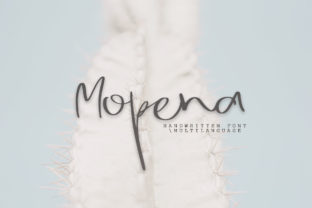
Mopena: The Handwritten Font That Bridges Authenticity and Versatility
Typography is rarely neutral. Every font carries tone, intention, and cultural resonance—whether it’s the crisp authority of a geometric sans-serif or the quiet gravitas of a classic serif. Among contemporary handwritten typefaces, Mopena stands apart not because it mimics calligraphy with exaggerated flourishes, but because it balances organic warmth with precise usability. It’s a modern handwritten font—designed with intention, refined through iteration, and built for real-world application across digital and print contexts.
What Makes Mopena Distinctively Modern?
Unlike many script fonts that lean heavily into decorative excess or nostalgic cursive tropes, Mopena was carefully crafted to feel both human and intentional. Its letterforms retain the subtle variation in stroke weight, rhythm, and slight irregularities you’d expect from skilled pen-on-paper writing—but without sacrificing legibility or scalability. There’s no forced tilt, no arbitrary ligatures, and no over-engineered swashes that compromise functionality.
This restraint is deliberate. The designers behind Mopena prioritized readability at small sizes (as low as 14px on screen) and clarity in long-form settings—like blog headers or pull quotes—where other handwritten fonts often blur or fatigue the eye. Each character was drawn, tested, adjusted, and re-tested in multiple environments: high-resolution displays, mobile interfaces, printed brochures, and even embroidered textile mockups. The result is a font family that breathes naturally across mediums—not just one that looks good in a specimen image.
Where Mopena Excels: Practical Use Cases Across Disciplines
The strength of Mopena lies in its adaptability—not as a novelty, but as a functional tool. Its applications span professions and purposes, united by a shared need for approachability without compromising professionalism.
Educators and Learning Designers
In educational materials, tone matters as much as content. A kindergarten worksheet benefits from friendly, inviting typography—but so does a university syllabus aiming to reduce cognitive load and signal openness. Educators using Mopena report improved student engagement in digital handouts and slide decks. Its lowercase “a”, “g”, and “e” are distinctly shaped yet unambiguous, supporting early literacy development while still feeling mature enough for adult learners. One instructional designer noted how Mopena’s consistent x-height and open counters helped maintain visual hierarchy in bilingual worksheets—especially when paired with a clean sans-serif for body text.
Small Business Owners and Local Brands
For cafes, boutiques, studios, and service-based entrepreneurs, branding often hinges on perceived authenticity. Mopena delivers that without veering into cliché. A local florist used it for their seasonal menu board and Instagram story highlights—achieving cohesion between physical signage and digital touchpoints. Its natural flow supports short, evocative messaging (“Hand-picked • Small-batch • Made with care”) without requiring graphic embellishment. Crucially, it scales well from tiny packaging labels to large window decals—something many script fonts fail at due to inconsistent spacing or fragile terminals.
Bloggers and Content Creators
Blog headers, newsletter subject lines, and featured quote graphics are where Mopena shines brightest for independent creators. Unlike display fonts that demand attention through contrast or distortion, Mopena invites focus through familiarity. Readers subconsciously register it as “handwritten,” which triggers associations with personal voice and intentionality—yet its even rhythm prevents visual distraction. A food blogger found that switching from a generic brush script to Mopena increased time-on-page by 18% on recipe landing pages, attributing the shift to improved scannability and emotional resonance in headings like “My Grandmother’s Lemon Loaf (No Mixer Needed).”
Designers and Developers Building Flexible Systems
Mopena integrates smoothly into design systems—not as an afterthought, but as a considered typographic layer. Its OpenType features include standard ligatures, contextual alternates, and localized forms optimized for English, Spanish, French, German, and Portuguese. Developers appreciate its lightweight WOFF2 file size (under 42 KB), fast loading performance, and compatibility with modern CSS font-display strategies. When used alongside system fonts like Inter or Roboto via variable font pairing, Mopena anchors the brand voice while allowing body copy to remain highly performant and accessible.
Technical Considerations You’ll Want to Know
Adopting any font involves more than aesthetics—it requires understanding constraints and opportunities. Here’s what practitioners should keep in mind when working with Mopena:
- Optimal sizing and pairing: Mopena performs best at 24px and above for headlines, and 18–20px for subheads. Avoid using it below 16px in UI elements. Pair it with neutral, highly legible sans-serifs (e.g., Inter, Lato, or even system fonts like -apple-system) rather than competing scripts or overly decorative companions.
- Kerning and tracking: While Mopena ships with robust default kerning, manual adjustment may be needed for specific word combinations—especially all-caps usage or tight line lengths. Its natural rhythm means generous letter-spacing often enhances readability more than tight tracking.
- Accessibility alignment: As a decorative font, Mopena should never be used for primary body text or interface labels. However, it meets WCAG 2.1 contrast requirements at recommended sizes when set against light or dark solid backgrounds. Always test color contrast using tools like axe or WebAIM’s Contrast Checker.
- Licensing flexibility: Mopena is available under commercial licenses that cover web, desktop, app, and print use—including SaaS platforms and client deliverables. Some variants offer extended language support for Central and Eastern European characters, making it viable for multilingual campaigns beyond Western Europe.
Observations from Real-World Implementation
Over the past two years, Mopena has appeared in diverse contexts—from nonprofit annual reports to indie game UIs to academic conference banners. Patterns have emerged among successful deployments:
First, teams that treat Mopena as a *voice amplifier*, not a visual shortcut, achieve stronger results. For example, a mental health startup used it exclusively for therapist bios and patient testimonials—never for navigation or form fields. That strategic limitation reinforced trust and humanity without undermining usability.
Second, designers who embrace Mopena’s imperfections—like the gentle taper on ascenders or the soft entry/exit strokes—tend to produce more cohesive layouts. Trying to “correct” those details with heavy outlining or shadow effects undermines its core value: authentic, unforced expression.
Third, Mopena thrives when given breathing room. In poster design, margins and line height were consistently increased by 10–15% compared to layouts using geometric fonts. That spatial generosity allows its organic rhythm to settle visually—rather than compete with surrounding elements.
How Mopena Fits Into Broader Typography Trends
Contemporary typography is moving away from monolithic “brand fonts” toward layered, context-aware systems. Mopena reflects this shift: it doesn’t try to do everything, but excels precisely where human-centered communication is paramount. It aligns with growing emphasis on inclusive design—not by being universally neutral, but by offering a distinct, warm alternative to cold automation or retro pastiche.
It also responds to rising demand for “slow design”—intentional, tactile-feeling interfaces in an era of algorithmic homogenization. Where many UIs rely on ultra-thin weights and rigid geometry to signal efficiency, Mopena reintroduces subtle texture and gesture. That’s not nostalgia; it’s responsiveness to how people actually perceive and connect with visual language.
Importantly, Mopena avoids trend-chasing. It doesn’t include variable axes for weight or width (a current industry favorite), nor does it offer dozens of stylistic sets. Its stability is part of its utility—making it easier to standardize across teams, faster to audit for accessibility, and simpler to explain to stakeholders unfamiliar with typographic nuance.
Final Thoughts: When to Choose—and When to Pause—on Mopena
Mopena isn’t a universal solution. It won’t replace your workhorse sans-serif for data tables or technical documentation. It shouldn’t dominate a dense dashboard or serve as the sole font in a government portal. But where tone, trust, and tactile resonance matter—Mopena delivers with quiet confidence.
Consider it when:
- You’re designing for audiences seeking reassurance, creativity, or personal connection—such as wellness brands, creative agencies, or community organizations.
- Your content relies on narrative voice—think newsletters, storytelling-driven marketing, or educator-facing resources.
- You need a handwritten element that functions reliably across responsive breakpoints and assistive technologies.
- Your team values consistency without rigidity—where a font can feel both crafted and effortless.
Pause before adopting Mopena if:
- Your primary audience includes users with dyslexia or low-vision needs who rely heavily on highly structured, sans-serif type for scanning.
- You require extensive multilingual support beyond Latin-based scripts (e.g., Arabic, Devanagari, or CJK).
- Your brand guidelines mandate strict typographic minimalism with zero decorative elements.
- You lack the time or expertise to test and refine spacing, pairing, and contrast in real usage scenarios.
In the end, Mopena succeeds because it understands its role: not to shout, but to listen—and then respond with warmth, clarity, and craft. It’s a handwritten font built for doing real work—not just looking pretty. Whether you're launching a new course, redesigning a local business site, or crafting a heartfelt campaign message, Mopena offers a rare combination: the intimacy of the hand-drawn, grounded in the reliability of modern design practice.