Miolleta Script: A Thoughtful Choice for Expressive, Human-Centered Typography
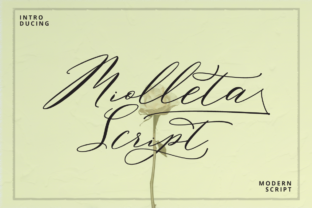
Miolleta Script is a hand-drawn display font that balances classic calligraphic rhythm with intentional modern imperfection. It’s not a rigid script nor a fully automated brush type—it lives in the subtle space between control and spontaneity. Its defining traits include a gently undulating baseline (often described as “dancing”), variable stroke contrast, slight irregularities in letterforms, and soft, open counters. These aren’t flaws; they’re deliberate design choices meant to evoke warmth, authenticity, and quiet confidence.
What Sets Miolleta Script Apart—Beyond Aesthetic Preference
Many script fonts aim for either polished elegance or raw, energetic looseness. Miolleta Script occupies a middle ground: it avoids the stiffness of formal copperplate while resisting the chaotic energy of some freehand alternatives. The dancing baseline adds movement without sacrificing legibility at larger sizes—especially important when used for headers, signage, or digital sliders. Its clean construction means letters don’t visually compete, even in tight layouts like escort cards or packaging labels.
Unlike many contemporary scripts built from vector-based brush strokes, Miolleta Script was designed with print and physical applications in mind. Its spacing, weight distribution, and x-height were refined to hold up well on textured paper, foil-stamped surfaces, or embossed invitations. That attention to tactile context makes it especially relevant for wedding stationery, custom stamps, or artisanal product packaging—where how the type feels in hand matters as much as how it looks on screen.
Where Miolleta Script Fits in Real-World Design Workflows
Designers often reach for script fonts in specific scenarios: to signal celebration, intimacy, craftsmanship, or personal voice. Miolleta Script excels when the goal is understated expressiveness—not flashiness. For example:
- Wedding invitations: Its gentle rhythm supports elegant but approachable tone—ideal for couples who want tradition without formality.
- Table numbers and escort cards: The clear letterforms remain legible at small sizes (down to ~14pt), and its irregularity prevents visual monotony across dozens of cards.
- Brand identity systems: Used selectively—as a logo lockup or headline treatment—it adds distinct personality without overwhelming supporting sans-serif or serif text.
- Digital displays: On sliders, hero banners, or blog headers, Miolleta Script performs well at scale, particularly when paired with generous line height and high-contrast backgrounds.
It’s less suited for body copy, long-form editorial use, or UI elements requiring rapid scanning. Its expressive nature demands breathing room—and benefits from thoughtful pairing. A neutral sans-serif (like Inter, Lato, or Montserrat) or a low-contrast serif (such as Merriweather or Cormorant Garamond) often provides effective balance.
Comparing Approaches: When Miolleta Script Aligns—or Doesn’t
Choosing a script font isn’t just about liking how it looks. It’s about matching typographic behavior to functional needs and audience expectations. Miolleta Script stands out in contexts where perceived authenticity matters more than absolute uniformity.
Consider two common alternatives: highly structured formal scripts (e.g., those modeled on Spencerian or Engrosser’s scripts) and loose, gestural brush fonts. Formal scripts communicate tradition, prestige, or ceremony—but can feel distant or overly rigid for modern brands or casual celebrations. Brush fonts offer energy and immediacy—but sometimes sacrifice readability, especially in smaller applications or lower-resolution outputs.
Miolleta Script offers a third path: human-made texture without sacrificing clarity. It’s not trying to mimic penmanship perfectly—instead, it uses variation purposefully. That makes it adaptable across media: it translates well to laser-cut wood signs, letterpress printing, web typography (via WOFF2), and even embroidery digitizing—where consistent stroke weight and open shapes reduce stitching complexity.
Practical Tradeoffs to Keep in Mind
No script font works universally. With Miolleta Script, awareness of its strengths also means acknowledging its constraints:
- Limited language support: It covers Latin-based languages thoroughly—including accented characters used in French, Spanish, and German—but doesn’t extend to Cyrillic, Greek, or extended diacritic sets. Projects requiring multilingual support may need supplemental typefaces.
- No optical sizing variants: Unlike some professional type families, Miolleta Script doesn’t include separate cuts optimized for text, subhead, or display. Designers adjust tracking, weight, and size manually based on context.
- Lower-case dominance: While it includes full upper- and lowercase sets, its character and charm emerge most strongly in mixed-case settings. All-caps usage flattens its rhythm and diminishes its baseline movement.
- Spacing requires attention: Its natural unevenness means default kerning pairs may need manual adjustment—particularly around punctuation, numerals, or tight letter combinations like “To” or “Wa.”
These aren’t shortcomings—they’re design parameters. They mean Miolleta Script rewards intentionality. It’s best deployed by designers or communicators who understand how typography functions in context—not just how it decorates a layout.
When Miolleta Script Is Likely the Right Fit
Miolleta Script tends to resonate most strongly in projects where:
- The brand or event values handmade nuance over machine-perfect consistency;
- Legibility at medium-to-large sizes is essential, but strict typographic neutrality isn’t the goal;
- The audience responds to warmth and approachability—think boutique services, creative studios, artisanal goods, or milestone celebrations;
- Production methods include physical media (letterpress, foil stamping, engraving) where subtle variation enhances perceived quality;
- Designers have time to refine spacing and test real-world output—not just preview on screen.
A bakery launching seasonal packaging might choose Miolleta Script for its “handwritten recipe card” feel. A photographer building a portfolio site could use it sparingly in section headers to reinforce a personal, curated aesthetic. A nonprofit hosting an intimate gala may select it for invitation suites—conveying care and individual attention without overt opulence.
When Another Option May Serve Better
Miolleta Script isn’t ideal when:
- Consistency across global markets is non-negotiable (due to its limited character set);
- Text must be dynamically generated at scale (e.g., personalized email headers with variable names), where unpredictable spacing or ligature behavior could cause rendering issues;
- The project demands high legibility at very small sizes (under 12pt) or low resolution (e.g., mobile app buttons or QR code labels);
- The visual identity prioritizes stark minimalism or geometric precision—where even subtle baseline movement feels at odds with the broader system.
In those cases, a carefully chosen sans-serif with humanist qualities—or a tightly engineered script with expanded language support—may better align with functional requirements.
Making a Grounded Decision
Typography choices accumulate meaning over time. Miolleta Script contributes a particular kind of resonance: one rooted in visible effort, quiet variation, and restrained elegance. It’s worth testing early—not just as a visual sample, but in actual use: printed on your intended paper stock, rendered at target screen sizes, applied to real content blocks. Does it support the message—or distract from it? Does it feel cohesive alongside your other design elements?
There’s no universal “best” script font—only the most appropriate one for a given purpose, audience, and medium. Miolleta Script earns its place when authenticity, tactility, and graceful motion matter more than flawless replication. If those qualities match your goals, it’s a resource worth exploring deeply—not just as decoration, but as part of your communication strategy.