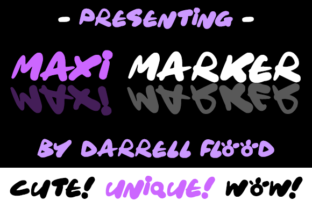
Maxi Marker Font: A Bold, Expressive Choice for Art, Education, and Creative Design
The Maxi Marker font is more than just a playful typeface—it’s a visual tool that bridges creativity, accessibility, and expressive communication. Designed to mimic the natural flow and texture of hand-drawn marker strokes, Maxi Marker stands out with its thick, dynamic letterforms and intentional variation in line width. Whether you’re an educator designing classroom posters, an illustrator sketching concept art, or a parent crafting personalized birthday banners, this font brings energy, warmth, and childlike authenticity to any project.
What Is Maxi Marker—and Why Does It Feel So Familiar?
At its core, Maxi Marker is a display font—meaning it’s optimized for headlines, signage, invitations, and short bursts of high-impact text rather than long-form reading like body copy. Its defining trait is its variable stroke weight: vertical stems are bold and robust, while horizontal crossbars or curved terminals taper slightly, echoing how a real marker behaves when pressed firmly on paper and then lifted lightly. This organic inconsistency isn’t a flaw—it’s the font’s signature charm.
Unlike rigid geometric sans-serifs or ultra-refined serifs, Maxi Marker embraces imperfection. Letters tilt subtly, corners round gently, and spacing feels generous—not mechanical. That human touch makes it especially effective in contexts where warmth, approachability, and spontaneity matter most.
How Maxi Marker Differs From Similar Fonts
It’s easy to confuse Maxi Marker with other “marker-style” fonts—but key distinctions set it apart:
- Not a script font: While fluid, Maxi Marker is not connected cursive. Each letter stands independently, making it highly legible—even at smaller sizes or in low-resolution prints.
- Not overly cartoonish: Unlike some kid-focused fonts with exaggerated eyes or bouncing baselines, Maxi Marker maintains clean structure and typographic integrity. It’s fun without being frivolous.
- Designed for versatility: Many marker fonts sacrifice readability for flair. Maxi Marker balances both—retaining clear letter shapes (e.g., distinguishable a, g, and 9) while keeping its expressive soul intact.
Where Maxi Marker Shines: Real-World Applications
Understanding *where* and *why* Maxi Marker works helps unlock its full potential. Below are practical, everyday uses backed by design logic and user experience principles.
1. Early Childhood Education & Learning Materials
In preschools, kindergartens, and homeschool environments, Maxi Marker supports literacy development through visual familiarity. Children recognize letters drawn with thick markers long before they encounter sleek digital fonts. Using Maxi Marker in flashcards, alphabet charts, or interactive worksheets reinforces letter shape recognition and builds confidence. Its open counters (the enclosed spaces in a, e, o) and generous x-height improve clarity—key factors for emerging readers.
2. Art Classrooms and Creative Workshops
Art teachers use Maxi Marker for project titles (“My Nature Collage”), gallery labels, and technique instructions (“Try Layering First!”). Because it mirrors tools students already use—broad-tip markers, paint pens, chalk—it creates continuity between digital planning and hands-on creation. Students also respond well to seeing their own work paired with a font that feels like part of the artistic process—not something separate or “technical.”
3. Branding for Family-Friendly Businesses
Local studios, children’s museums, craft supply shops, and pediatric clinics often adopt Maxi Marker in logos, signage, and social media graphics. Its friendly tone signals inclusivity and playfulness without sacrificing professionalism. For example, a community pottery studio named “Clay & Co.” might use Maxi Marker for its workshop schedule poster—immediately communicating creativity, hands-on learning, and welcoming energy.
4. DIY Projects and Personalized Keepsakes
From custom water bottles to illustrated storybooks to birthday party banners, Maxi Marker adds handmade appeal to digital designs. Pair it with hand-drawn icons or textured backgrounds, and the result feels tactile—even on screen. Its strong presence ensures legibility on fabric prints, vinyl decals, and large-format posters.
Common Misconceptions About Maxi Marker
Despite its widespread appeal, several assumptions can limit how effectively designers and educators use Maxi Marker. Let’s clarify:
- “It’s only for kids.” While ideal for youth-oriented contexts, Maxi Marker also thrives in retro branding, indie publishing, festival posters, and even food truck menus seeking a vibrant, artisanal vibe.
- “It doesn’t work digitally.” On the contrary—its bold forms render crisply on tablets, smartboards, and mobile devices. When used sparingly (e.g., app headers or button labels), it enhances UX by guiding attention and conveying tone.
- “Any thick font will do the same job.” Not quite. Generic bold sans-serifs lack the nuanced stroke modulation and rhythmic variation that make Maxi Marker feel alive. That subtle dynamism supports visual hierarchy and emotional resonance in ways static fonts cannot replicate.
Pairing Maxi Marker With Other Typefaces
Like any strong personality, Maxi Marker benefits from thoughtful companionship. For balanced layouts, pair it with:
- A simple, neutral sans-serif (e.g., Open Sans, Lato, or Montserrat) for body text—creating contrast without competition.
- A soft serif (e.g., Merriweather or Playfair Display) for elegant yet warm combinations, ideal for storytelling or educational websites.
- A monospace or typewriter font for creative juxtaposition—think “artist’s journal” aesthetics in digital portfolios or zine designs.
Avoid pairing Maxi Marker with other highly decorative or similarly heavy fonts—they’ll visually cancel each other out. Simplicity and breathing room let its expressiveness shine.
Accessibility Considerations
While Maxi Marker excels in engagement, accessibility should never be an afterthought. Here’s how to use it responsibly:
- Use it for headings and short labels only—never for paragraphs, legal disclaimers, or dense interface text.
- Maintain sufficient color contrast (minimum 4.5:1 against background) to support users with low vision.
- Ensure fallback fonts are defined in CSS so browsers display readable alternatives if Maxi Marker fails to load.
- Test across devices, especially on assistive technologies—some screen readers handle decorative fonts unpredictably unless properly labeled with
aria-labelorrole="img".
Why Maxi Marker Matters in Today’s Visual Landscape
In an age saturated with algorithmically generated content and AI-polished aesthetics, fonts like Maxi Marker serve as quiet reminders of human intention and tactile joy. They resist homogenization. They invite participation—not passive scrolling. In education, they honor developmental stages. In business, they signal authenticity over automation. And in personal projects, they empower non-designers to create with confidence.
More than a stylistic choice, Maxi Marker reflects a broader shift toward human-centered design: prioritizing emotion, inclusivity, and context over pure efficiency. As digital tools grow more powerful, our appreciation for textures, irregularities, and expressive imperfections deepens—not despite technology, but because of it.
Getting Started With Maxi Marker
Maxi Marker is widely available through major font platforms including Google Fonts, Font Squirrel, and commercial foundries. Always verify licensing—many versions are free for personal use, while commercial applications may require a one-time purchase or subscription.
Pro tip: Start small. Try replacing a single headline in your next newsletter, lesson plan, or social graphic. Notice how it changes the mood—not just aesthetically, but emotionally. That’s the power of intentional typography.
Whether you're nurturing young minds, launching a creative venture, or simply rediscovering the joy of making things by hand (or screen), Maxi Marker offers more than style—it offers connection, clarity, and a little bit of joyful noise in a world that often feels too quiet, too perfect, and too fast.