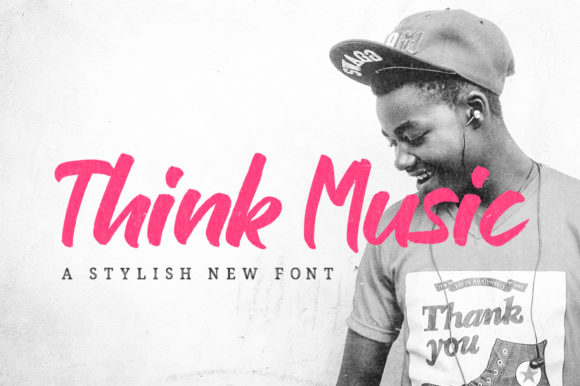
Think Music: A Thick Brush Font for Expressive, Rhythmic Typography
Think Music is a distinctive thick brush font designed by Salt and Pepper Design. It belongs to the broader category of hand-drawn script fonts—but stands apart through its deliberate weight, rhythmic flow, and intentional chunkiness. Unlike delicate calligraphic scripts or tightly kerned display fonts, Think Music leans into boldness and texture. Its letterforms carry visible brush pressure, subtle tapering, and organic irregularities that suggest movement—like a bassline with presence or a vocal phrase held just long enough to resonate.
What Makes Think Music Different From Other Brush and Script Fonts?
Most brush fonts fall along a spectrum: some prioritize legibility at small sizes (e.g., for labels or UI), others emphasize flair for headlines or logos. Think Music sits firmly in the latter camp—but with nuance. Its thickness isn’t uniform; it varies across strokes to create visual rhythm. Uppercase letters often feature extended swashes or exaggerated terminals, while lowercase forms retain enough openness to avoid clutter in short phrases. This balance allows it to function well in contexts where personality matters more than precision—such as album art, event posters, or brand accents.
Compared to lighter brush fonts like Brusher or Indie Flower, Think Music carries significantly more visual weight and presence. That makes it less suitable for body text or interfaces requiring scanning, but far more effective when you need typography to hold attention without competing with imagery. It also differs from monoline scripts (e.g., Playlist Script) by embracing contrast—not in thin-to-thick transitions like copperplate, but in dense-to-airy spacing and stroke density.
Where Think Music Fits Into Real-World Design Workflows
Designers often reach for Think Music when they want to evoke energy, authenticity, or musicality—without relying on literal icons or clichéd notation. Its name isn’t metaphorical: it’s built to feel like sound made visible. That means it works especially well in projects tied to creative industries—music branding, podcast identities, indie film titles, or artisanal product packaging.
For example:
- A vinyl record label might use Think Music for band names on spine labels—its thickness holds up in miniature print while retaining character.
- A coffee shop launching a weekly live jazz series could apply it to window decals or social media banners—its warmth and motion complement the experience without overwhelming it.
- An illustrator designing merch for a synth-pop artist may layer Think Music behind hand-drawn elements, letting its texture interact naturally with ink or grain.
It’s less effective—and potentially counterproductive—in contexts demanding neutrality, scalability across devices, or multilingual support. Think Music includes standard Latin characters and basic punctuation, but lacks extended language support (e.g., Central/Eastern European diacritics, Cyrillic, or Vietnamese tone marks). If your project targets global audiences or requires dynamic text rendering (like CMS-driven websites), this limitation warrants careful evaluation.
Strengths and Practical Tradeoffs
Strengths:
- Strong visual identity: Stands out immediately in crowded layouts without needing extra effects.
- Natural rhythm: Letter spacing and baseline variation encourage reading as phrases—not isolated words—making it ideal for short, evocative copy.
- Print-friendly density: Its weight translates reliably to physical media, including screen printing and foil stamping.
- Low barrier to entry: No complex OpenType features required; works well with basic font loading and fallback strategies.
Tradeoffs:
- Limited hierarchy options: Because it’s inherently bold and expressive, pairing it with other fonts requires intention. It doesn’t scale down gracefully for captions or footnotes.
- Reduced readability in longer passages: Even at 24px on screen, extended use strains comprehension—especially for readers with visual processing preferences or dyslexia.
- Few stylistic variants: No italic, light, or condensed versions exist. That restricts typographic flexibility within a single family.
- File size and licensing: As a commercial font, it requires proper licensing for web or app embedding—unlike many free alternatives with similar aesthetics but fewer usage rights.
When to Choose Think Music—And When to Look Elsewhere
Think Music shines when your goal is emotional resonance over functional neutrality. If you’re designing a festival poster where “FEEL THE BEAT” appears above a photo of a crowd mid-jump, Think Music adds kinetic energy without shouting. Likewise, if you’re developing a logo lockup where the wordmark must communicate both craft and confidence—say, for a boutique audio studio—its tactile quality reinforces authenticity.
But if your needs include:
- Dynamic content generation (e.g., user-generated quotes or data-driven headlines),
- Accessibility-first requirements (WCAG AA/AAA compliance for contrast and font rendering),
- Multi-font systems needing optical consistency across weights and widths,
- Or environments where performance matters (e.g., low-bandwidth mobile experiences where font file size impacts load time),
…then Think Music may not be the optimal choice—even if it’s visually appealing. In those cases, evaluating alternatives with broader language coverage, variable axes, or lighter file footprints becomes necessary. That doesn’t mean rejecting Think Music outright—it means recognizing its role as a specialist tool rather than a universal one.
Pairing Think Music Thoughtfully
Successful pairing hinges on contrast—not competition. Think Music pairs best with typefaces that offer structural clarity and restrained voice. Sans serifs with generous x-heights and open apertures (e.g., Inter, Manrope, or Work Sans) provide grounding without visual noise. Avoid other high-contrast or decorative fonts unless the intent is deliberate dissonance—like using a rigid geometric sans next to Think Music to highlight tension between order and expression.
In editorial layouts, reserve Think Music for pull quotes, section headers, or chapter titles—not running text. Use it at sizes where individual letterforms remain legible (typically 32px and up on screen, 18pt+ in print), and allow generous line-height (1.4–1.6) to preserve its breathing room.
Making an Informed Decision
Choosing Think Music isn’t about whether it’s “good”—it’s about whether it serves your specific constraints and goals. Ask yourself:
- Is the message short, emotive, and benefit-driven—or descriptive, technical, or instructional?
- Will users encounter this text once (a poster) or repeatedly (a navigation menu)?
- Do you control the environment (a printed brochure) or share it (a responsive website with unknown devices)?
- Does your team have capacity to test legibility across real-world conditions—or are you relying on visual intuition alone?
There’s no universal “best” font—only better fits for particular situations. Think Music earns its place when authenticity, motion, and tonal warmth matter more than adaptability. It’s not a replacement for system fonts or workhorse families. It’s a deliberate accent—a sonic highlight in a visual composition. Used with awareness of its limits and strengths, it deepens meaning. Used without consideration, it risks obscuring it.
If you value craftsmanship in type design and need a font that behaves like a signature rather than a utility, Think Music deserves close review. Just ensure your evaluation includes testing in context—not just in mockups, but with real content, real users, and real constraints.