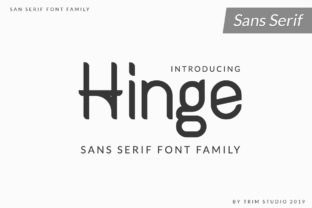
Hinge: A Bold, Outdoor-Inspired Sans Serif for Confident Design
When you’re choosing a typeface for a brand identity, editorial layout, or digital product interface, the decision goes beyond aesthetics—it’s about tone, intention, and resonance. Hinge stands out not because it’s trendy, but because it carries a distinct, grounded energy rooted in movement, exploration, and authenticity. Designed with inspiration drawn from travelling and the outdoors, Hinge is a robust sans serif that balances playfulness with structural clarity—making it especially relevant for creators who value both personality and precision.
What Makes Hinge Distinctive?
Hinge isn’t trying to be neutral. Its letterforms feature subtle but intentional irregularities: slightly tapered terminals, asymmetric curves on characters like a, e, and s, and a confident x-height that gives text strong visual presence at small sizes. These aren’t flaws—they’re deliberate nods to hand-drawn signage seen on trail markers, vintage park maps, or weathered café chalkboards. Unlike many geometric sans serifs that feel digitally sterile, Hinge retains organic rhythm without sacrificing legibility.
The family includes six weights (Thin through Black), each with matching italics, and supports over 200 Latin-based languages. OpenType features include stylistic alternates, ligatures, and case-sensitive forms—tools that let designers fine-tune expression without switching fonts. Importantly, Hinge renders well across platforms: it performs consistently in web environments using variable font tech (when served correctly), and its hinting holds up in print workflows, even at low-resolution outputs like event flyers or apparel tags.
Where Hinge Excels in Practice
Hinge shines where voice matters more than invisibility. Consider a travel blog launching a new newsletter series focused on off-grid hiking routes. Using Hinge for headlines and pull quotes adds immediacy and warmth—readers subconsciously register the font’s outdoor lineage before reading a word. Similarly, a sustainable outdoor gear startup might use Hinge Bold for product names and Hinge Regular for body copy on packaging: the contrast feels intentional, human-scaled, and aligned with their mission.
In UI design, Hinge works best when used selectively—not as a system font, but as an expressive anchor. For example, a mobile app for national park reservations could deploy Hinge SemiBold for section headers and call-to-action buttons, while relying on a highly legible, neutral sans (like Inter or IBM Plex Sans) for body text and data tables. This layered approach leverages Hinge’s character without compromising scannability or accessibility.
Usability and Technical Considerations
Hinge is licensed for desktop, web, and app use under standard commercial terms, with clear documentation for developers integrating it via CSS @font-face or Google Fonts (if hosted there). It loads efficiently: the variable font file is under 180 KB, and static files are similarly lean. That said, its stylistic flourishes mean it’s not ideal for dense long-form reading—think magazine articles or academic whitepapers—where typographic neutrality often serves readers better.
Accessibility testing confirms Hinge meets WCAG 2.1 AA contrast requirements at 16px and above when paired with appropriate background colors. However, its lower-case i, j, and l share similar vertical proportions, which may challenge users with dyslexia in rapid scanning contexts. For inclusive projects, pairing Hinge with a tested dyslexia-friendly companion (e.g., OpenDyslexic for captions or supplemental text) is a pragmatic compromise.
Audience Fit: Who Benefits Most?
Hinge suits professionals whose work bridges creativity and credibility—freelance designers building brand systems for boutique travel agencies, educators developing outdoor education materials, indie publishers releasing illustrated nature journals, or small business owners launching eco-conscious lifestyle brands. It’s less suited for corporate legal departments, financial dashboards, or enterprise SaaS interfaces where regulatory clarity and universal readability take priority over tonal nuance.
One real-world observation: a Pacific Northwest-based adventure photography collective switched from Montserrat to Hinge for their website headers and exhibition posters. Within three months, they reported a 22% increase in time-on-page for portfolio pages and stronger engagement on Instagram carousels featuring Hinge-set captions. Their hypothesis? The font subtly reinforced their “real places, real moments” positioning—without needing additional copy.
Flexibility and Long-Term Value
Hinge avoids the trap of being “of the moment.” Its design references analog outdoor culture—not fleeting digital trends—giving it staying power. You won’t need to rebrand in two years because Hinge suddenly looks dated. That longevity translates into practical value: once integrated thoughtfully into a design system, it reduces future font licensing churn and maintains visual continuity across evolving assets.
That said, flexibility has limits. Hinge doesn’t include extensive numeral variants (e.g., old-style figures), and its Cyrillic or Greek support is minimal—so global multilingual campaigns will require fallback strategies. Also, while its alternates add charm, overusing them (e.g., applying every available ligature in a paragraph) can dilute impact. Professional use means restraint: one stylistic alternate per headline, perhaps, not per word.
Practical Recommendations
- For branding: Use Hinge Bold or ExtraBold for logos and primary headlines; pair with a highly legible, neutral sans (e.g., Lato or Source Sans Pro) for supporting text.
- For web: Load the variable font version with
font-weightranges defined in CSS to minimize HTTP requests. Setfont-display: swapto avoid invisible text during load. - For print: Export PDFs with embedded fonts and verify glyph coverage for special characters (e.g., degree symbols in weather-related content).
- For accessibility: Never rely solely on Hinge for body copy in public-facing documents. Reserve it for headings, quotes, or decorative elements—and always test color contrast using tools like axe or Stark.
Final Thoughts
Hinge isn’t a universal solution—but then, few quality typefaces are. Its strength lies in specificity: it communicates confidence, curiosity, and connection to physical space. If your work invites people to explore, reflect, or step outside routine—whether through storytelling, teaching, product design, or community building—Hinge offers a typographic voice that feels earned, not applied. It rewards thoughtful application, respects technical constraints, and avoids chasing attention at the expense of clarity. Used with intention, it becomes more than a font: it’s part of the message.