Lamberto Family: A Comprehensive Evaluation for Designers and Brand Professionals
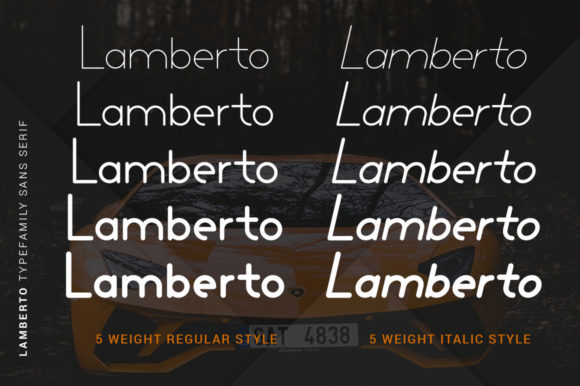
The Lamberto Family is a large, versatile sans serif typeface system comprising 20 distinct variations. Designed with clarity and visual impact in mind, it spans multiple weights, widths, and stylistic alternatives—including upright and italic forms—each carefully engineered to maintain consistency across scales and applications. Unlike many display-oriented fonts, Lamberto balances strong personality with functional legibility, making it relevant not only for headline use but also for supporting text in controlled environments.
Why Designers and Marketers Consider Lamberto Family
Professionals often explore Lamberto Family when seeking a typeface that supports both expressive branding and practical versatility. Its 20 variations allow for nuanced typographic hierarchies without sacrificing cohesion—a benefit particularly valuable in multi-channel brand systems. For example, a single weight may anchor a logo, while lighter or condensed variants handle captions, social media overlays, or packaging copy.
Photographers and visual creatives frequently turn to Lamberto Family for watermarks and portfolio presentation due to its clean geometry and high contrast between letterforms and background. Similarly, marketers use it in digital ads and printed collateral where immediate readability and stylistic confidence matter—especially at small sizes on mobile screens or large formats like billboards.
Key Benefits of Using Lamberto Family
- Consistent visual language: All 20 styles share common proportions, stroke modulation, and x-height, reducing the risk of typographic dissonance across touchpoints.
- Strong performance in mixed-media contexts: Tested across print, web, and screen-based formats, Lamberto maintains legibility in low-resolution environments (e.g., Instagram story overlays) and high-fidelity outputs (e.g., luxury product labels).
- Efficient workflow integration: OpenType features—including ligatures, alternate numerals, and contextual substitutions—are built-in, supporting automation in design tools and CMS platforms that support variable font handling.
- Scalability: The family’s range includes ultra-light to black weights and narrow to extended widths, enabling fine-tuned control over spacing, emphasis, and density without switching to unrelated typefaces.
Tradeoffs and Practical Considerations
While Lamberto Family offers breadth, its size can introduce complexity. Managing 20 files requires thoughtful font-loading strategies on websites and disciplined naming conventions in design systems. Users should assess whether their project truly benefits from all available variants—or if a subset (e.g., three weights plus italics) would suffice for clarity and performance.
Legibility at very small sizes (below 10 pt in print or 14 px on screen) may vary by weight. Thin and hairline versions, while elegant, are less suitable for body text or accessibility-critical interfaces. Likewise, the family does not include dedicated caption or optical-size variants, so designers working with dense informational layouts may need to supplement with a secondary, more robust text face.
Licensing is another factor. Lamberto Family is typically distributed under commercial licenses with tiered usage rights—covering desktop, web, app, and server environments separately. Teams evaluating it for enterprise use should confirm coverage for intended deployment channels, especially in SaaS products or embedded digital signage.
Where Lamberto Family Fits Best
Lamberto Family excels in projects where typographic presence directly supports brand positioning. It is well-suited for:
- Brand identity systems requiring flexible yet unified typography across logos, business cards, and environmental graphics;
- Photography-based businesses needing cohesive watermarking, gallery text, and social media templates;
- Packaging and labeling for consumer goods where shelf impact and regulatory text legibility must coexist;
- Event branding, including wedding stationery, conference materials, and promotional banners where tone ranges from modern to refined;
- Digital advertising, especially static and animated assets where consistent rendering across browsers and devices is essential.
When Alternatives May Be More Appropriate
Lamberto Family prioritizes stylistic strength over neutrality. Projects demanding strict accessibility compliance—such as government portals, educational platforms, or healthcare interfaces—may benefit more from typefaces with higher x-heights, open counters, and tested WCAG 2.1 AA/AAA conformance (e.g., Inter, IBM Plex Sans, or Nunito). These options often include expanded language support and dedicated UI-optimized weights.
For long-form editorial content—like blogs, whitepapers, or newsletters—Lamberto’s display orientation may compromise reading comfort. In such cases, pairing it with a highly legible text companion (e.g., Lora, Source Serif Pro, or Libre Franklin) often yields better results than forcing Lamberto into extended paragraphs.
Teams operating under tight development constraints—especially those using legacy CMS platforms or older email clients—should verify fallback behavior. While Lamberto renders reliably in modern browsers, limited support for variable font axes or advanced OpenType features in some environments may necessitate conservative implementation (e.g., static WOFF2 subsets instead of full variable builds).
Making an Informed Decision
Evaluating Lamberto Family begins with clarifying your primary use case. Ask: Is visual distinction or functional neutrality more important? Do you need broad stylistic flexibility—or precision within a narrower scope? If your work centers on brand expression, visual storytelling, or short-form communication, Lamberto’s coherence and range are significant advantages.
Test it early and contextually. Import samples into real layouts—not just mockups—to assess spacing, line height interaction, and color contrast against your palette. Use browser developer tools to simulate slower network conditions and verify loading performance. Check how it behaves alongside your existing type stack, especially if integrating with system fonts or other web-hosted families.
Finally, consider long-term maintenance. A larger family increases the effort required for updates, documentation, and cross-team alignment. If your organization lacks established typography governance, starting with a curated subset—say, Regular, Medium, Bold, and one Condensed variant—can provide most benefits while minimizing overhead.
Lamberto Family is not a universal solution, but it is a purpose-built tool for specific design challenges. Its value emerges most clearly when matched thoughtfully to goals around recognition, consistency, and expressive clarity—not simply installed as default aesthetic choice. Evaluating it alongside project requirements, technical constraints, and audience needs leads to more sustainable, effective outcomes.