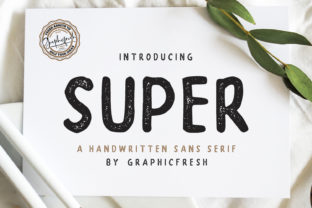
Super: A Modern Sans Serif That Speaks With Clarity and Quiet Confidence
Typography isn’t just about letters on a screen—it’s about tone, trust, and timing. In a world saturated with visual noise and fleeting attention, the fonts we choose carry unspoken weight. Super stands apart not by shouting, but by holding space with intention: a bold and distinctly modern sans serif font whose lovely charm lies in its balance—of strength and softness, geometry and warmth, precision and personality.
What Makes Super More Than Just Another Sans Serif?
At first glance, Super feels familiar—clean, legible, confidently neutral. But look closer. Its uppercase ‘S’ curves with subtle asymmetry; its lowercase ‘a’ and ‘g’ nod gently to humanist roots without sacrificing contemporary rhythm; its stroke contrast is restrained but perceptible, lending texture without distraction. Unlike ultra-thin or aggressively geometric alternatives, Super avoids austerity. It doesn’t demand attention—it earns it through consistency, readability at scale, and quiet authority.
This isn’t accidental design. Super was crafted for real-world use: responsive interfaces, dense dashboards, editorial layouts, brand systems that need to scale from mobile notifications to billboard campaigns. Its generous x-height and open counters ensure legibility even in low-resolution environments or at small sizes—a practical advantage in today’s fragmented device ecosystem.
Why Now? The Shift Toward Intentional Typography
Over the past five years, typography has quietly moved from background utility to foreground strategy. Designers, marketers, and product teams no longer treat fonts as interchangeable defaults. They’re selecting typefaces like voice actors—each one expected to reflect brand values, support accessibility goals, and adapt across contexts without losing coherence.
This shift mirrors broader changes: the rise of remote-first communication (where tone is harder to convey), the expectation of seamless cross-platform experiences, and growing awareness of inclusive design. A font that looks sharp on a 4K monitor but collapses into illegibility on a mid-tier Android phone undermines both usability and credibility. Super meets this moment—not by chasing novelty, but by solving persistent problems with thoughtful restraint.
From “Good Enough” to “Right Enough”
Think about the last time you opened a newsletter, scrolled through a SaaS dashboard, or read a blog post on your phone. Did any text feel off? Too tight? Too cold? Too effortful to parse? Those micro-frictions add up. Super addresses them—not with gimmicks, but with calibrated spacing, balanced proportions, and a weight range (from Light to Black) designed to work cohesively, not competitively.
For example, a freelance educator building an online course might use Super Bold for section headers (to anchor learning modules visually), Super Regular for body copy (for sustained reading comfort), and Super Light for subtle captions or metadata. No jarring transitions. No cognitive load from inconsistent rhythm. Just clarity, served consistently.
How Super Fits Into Evolving Creative and Business Workflows
Creative professionals increasingly rely on tools that prioritize speed *and* fidelity—Figma plugins that auto-generate typographic scales, CMS templates that enforce accessible contrast ratios, or no-code builders where font choice directly impacts SEO performance (via improved dwell time and reduced bounce rates). Super integrates cleanly into these ecosystems because it was built with technical pragmatism in mind: variable font support, robust OpenType features, and licensing options that accommodate everything from personal blogs to enterprise applications.
Business owners, especially those managing their own digital presence, benefit from Super’s versatility. A local café launching a new website doesn’t need a custom typeface—but they *do* need something that feels human, trustworthy, and unhurried. Super Regular conveys approachability; Super Medium adds just enough presence for call-to-action buttons without feeling aggressive. It supports storytelling without overshadowing the story.
Real-World Use Beyond the Obvious
- Educators: Using Super in slide decks and handouts improves retention—studies show moderate stroke contrast and open letterforms reduce eye strain during extended screen-based learning.
- Product teams: Integrating Super into design systems helps unify UI components across iOS, Android, and web—its consistent metrics mean buttons, cards, and form fields align predictably, speeding up developer handoff.
- Bloggers and writers: Pairing Super with a warm, readable serif (like Literata or IBM Plex Serif) creates elegant hierarchy—headings project confidence, body text invites immersion.
- Small studios: Offering Super as part of a brand identity package signals attention to detail without requiring clients to navigate complex licensing tiers.
Not Just for Designers: What Everyday Readers Gain
You don’t need to know kerning from tracking to appreciate what Super offers. As a reader, you’ve likely noticed how some websites feel easier to stay on—how paragraphs breathe, how headings land with quiet assurance, how lists scan effortlessly. That’s often the result of intentional typography. Super contributes to that experience by removing friction: no awkward line breaks, no ambiguous characters (like the oft-confused ‘I’, ‘l’, and ‘1’), no unexpected hyphenation in narrow columns.
It also adapts gracefully to changing conditions. On a bright afternoon, its generous letter spacing prevents glare-induced crowding. At night, its even weight distribution reduces visual fatigue compared to fonts with extreme contrast or compressed apertures. These aren’t flashy features—they’re humane ones.
Choosing Thoughtfully, Not Trendily
There’s no universal “best” font—and Super isn’t positioned as a replacement for every use case. It won’t suit a vintage whiskey label craving distressed ink or a children’s app demanding playful exaggeration. Its strength is in serving modern, content-forward needs where clarity, scalability, and calm authority matter more than ornamentation.
That said, adopting Super doesn’t require overhauling your entire system. Start small: replace a default system font in your email signature or newsletter preview. Test it in a single landing page section. Compare line height and paragraph spacing against your current choice—you’ll likely notice improved rhythm immediately.
And if you’re evaluating fonts for a new project, ask not just “Does this look good?” but “Does this support how people will actually use it?” Will it hold up in a dark-mode interface? Will it remain legible when zoomed to 200%? Does it pair naturally with your existing color palette and icon set? Super answers “yes” to all three—not because it’s perfect, but because it was designed for the conditions real users face, not idealized mockups.
A Font That Grows With You
Super’s relevance isn’t tied to a single trend—it’s rooted in durable principles: legibility across devices, expressiveness within constraint, and respect for the reader’s time and attention. As AI-generated content floods feeds and attention fragments further, the value of a font that communicates clearly—without demanding explanation—only increases.
It’s also a reminder that modernity doesn’t require sharp edges or constant reinvention. Sometimes, the boldest choice is the one that listens carefully, responds thoughtfully, and stays steady amid change. That’s the quiet power of Super: not to dominate the frame, but to hold it—with charm, clarity, and unwavering usefulness.