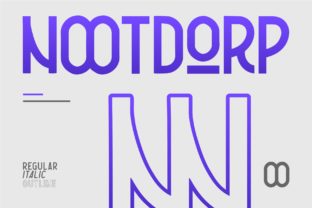
Nootdorp: A Modern Sans Serif Built for Clarity and Flexibility
Nootdorp is a contemporary sans serif typeface designed with intention—not just aesthetics, but utility. Its name draws from a real place: a district in the German city of Wuppertal, known for its layered urban fabric and quiet precision. That sense of grounded modernity carries into the font itself. Nootdorp isn’t trying to be nostalgic or experimental; it’s built to work across contexts without demanding attention for its own sake. It’s clean but not sterile, structured but not rigid, and legible at both small sizes on packaging labels and large scales in editorial layouts.
What Sets Nootdorp Apart From Other Contemporary Sans Serifs
Many modern sans typefaces fall into one of two camps: highly geometric (think tight spacing, uniform stroke widths, and near-perfect circles) or humanist (with open apertures, varied stroke contrast, and subtle calligraphic influence). Nootdorp occupies a deliberate middle ground. Its letterforms have gentle optical corrections—slightly flared terminals on ‘c’, ‘e’, and ‘s’; modest stroke modulation in uppercase letters; and generous x-heights that support readability without sacrificing elegance. These refinements aren’t obvious at first glance, but they become apparent in extended reading or when comparing side-by-side with more rigid alternatives.
Unlike fonts optimized exclusively for screen use—or those engineered solely for print—Nootdorp balances both. Its hinting and spacing are tuned for clarity on high-DPI displays, yet its ink traps and robust counters hold up well in offset printing, especially at smaller point sizes. That dual-readiness makes it practical for brands operating across digital and physical touchpoints: a logo on a website, product labels in retail, and editorial spreads in a quarterly magazine—all using the same core design language.
Three Styles, One Cohesive System
Nootdorp comes in three carefully calibrated weights: Regular, Medium, and Bold. There’s no light or extra-bold variant—and that’s intentional. The trio was developed to function as a complete, self-contained typographic system rather than an expansive family meant for every possible hierarchy need. Each weight shares identical proportions, spacing logic, and character width, so switching between them doesn’t disrupt alignment or rhythm in layouts.
- Regular serves well for body text, captions, and interface labels—offering neutrality without thinness.
- Medium provides reliable emphasis: ideal for subheads, pull quotes, or secondary branding elements where stronger presence is needed but full boldness would overwhelm.
- Bold anchors headlines, logos, and packaging front panels—confident but never aggressive.
This restraint avoids the visual noise that can come from overextended font families. With only three weights, designers retain control over hierarchy without defaulting to arbitrary weight jumps or inconsistent scaling. It also simplifies licensing and file management—especially useful for agencies managing multiple client projects or in-house teams maintaining brand consistency across departments.
Where Nootdorp Fits Best—And Where It Might Not
Nootdorp excels in applications where clarity, adaptability, and understated professionalism matter most. Consider these real-world examples:
- A sustainable skincare brand uses Nootdorp Regular for ingredient lists on recyclable tubes, Medium for product names on shelf tags, and Bold for its monogram logo—achieving continuity from lab to checkout.
- An independent magazine pairs Nootdorp Bold for section headers with a complementary serif for body text, letting the sans provide structure while the serif adds warmth and voice.
- A B2B SaaS company adopts Nootdorp across its dashboard UI, documentation, and investor pitch deck—ensuring consistent tone whether users are scanning metrics or reviewing long-form case studies.
That said, Nootdorp isn’t a universal solution. It lacks italics, condensed variants, or variable-axis support—so it won’t suit projects requiring dynamic width adjustments or expressive typographic contrast. If your work regularly demands strong stylistic differentiation (e.g., pairing a sharp sans with a dramatic script for luxury branding), Nootdorp’s even-tempered nature may feel too reserved. Similarly, for highly technical environments—like coding interfaces or data-dense dashboards—monospaced or ultra-legible system fonts might offer better functional precision.
How It Compares Across Common Use Cases
When evaluating typefaces for branding, many teams weigh factors like licensing scope, language support, and rendering behavior across platforms. Nootdorp includes Latin-based languages with full diacritic coverage (including Polish, Turkish, and Vietnamese), making it viable for international campaigns—but it does not currently support Cyrillic, Greek, or CJK scripts. That’s a practical limitation to note early if multilingual expansion is part of your roadmap.
In terms of licensing, Nootdorp follows standard desktop/web/app models, with clear usage tiers. Unlike some open-source sans fonts that require attribution or restrict commercial use, Nootdorp offers straightforward terms for businesses—though custom embedding (e.g., in mobile apps or e-learning platforms) may require additional permissions. Always verify license scope before finalizing production assets.
From a performance standpoint, its modest file size—especially compared to super-families with dozens of weights and widths—means faster load times and lighter CSS payloads. That’s meaningful for marketing sites where every hundred milliseconds impacts bounce rate, or for packaging designers who need to embed fonts reliably in PDF workflows without bloating file size.
Making the Call: Is Nootdorp Right for Your Project?
The strongest signal that Nootdorp fits your needs isn’t about trend alignment—it’s about workflow alignment. Ask yourself:
- Do you value consistency over stylistic variety? If your priority is unified communication—not dramatic contrast—Nootdorp’s focused range supports that goal.
- Are you balancing print and digital output? Its balanced metrics and rendering behavior reduce the need for workarounds across mediums.
- Is your team or client comfortable with restrained typography? Nootdorp doesn’t shout. It clarifies. If your audience responds better to confidence-through-clarity than flair-through-distinction, it’s a natural match.
- Do you need rapid implementation without extensive testing? Its predictable behavior across browsers, OS versions, and PDF engines lowers integration risk.
Conversely, if your project hinges on extreme customization—like responsive weight shifts, multi-script support, or expressive variation within a single family—other options may serve better. That doesn’t make Nootdorp lesser; it simply means its strengths lie in reliability, not range.
Final Thoughts for Designers and Decision-Makers
Type selection is rarely about finding the “best” font—it’s about matching design intent with functional reality. Nootdorp reflects a thoughtful approach: one that favors cohesion over complexity, legibility over ornamentation, and adaptability over novelty. It won’t solve every typographic challenge, but for teams building brands, publications, or products where trust, clarity, and cross-platform coherence matter, it offers a quietly capable foundation.
Before committing, test it in your actual context: set real copy at real sizes, view it on target devices, and compare how it behaves alongside your existing color palette, imagery, and layout constraints. Typography reveals its true character not in specimen sheets—but in use. And in that respect, Nootdorp has been designed to hold up, consistently, without drawing undue attention to itself.