Standard Pilot Handwritten Font
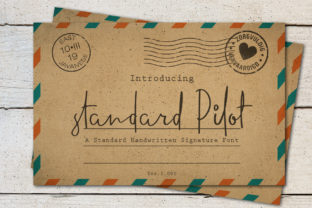
Standard Pilot is a digitally designed typeface that emulates the organic flow and subtle irregularities of handwriting produced with a ballpoint pen. Unlike calligraphic or brush-script fonts, it avoids dramatic flourishes and exaggerated contrast—instead prioritizing consistency, legibility, and authenticity in everyday handwritten expression. It was developed to reflect how people naturally write: slight variations in letter height, gentle slant, soft entry and exit strokes, and modest spacing between characters. These qualities make Standard Pilot particularly well-suited for contexts where approachability, personality, and human touch matter more than formal precision.
Designers, small business owners, illustrators, and content creators often seek fonts like Standard Pilot when they want to signal warmth, individuality, or craftsmanship without sacrificing readability. Its appeal lies not in novelty alone, but in its ability to function reliably across real-world applications—from printed stationery to digital interfaces—while retaining a hand-drawn sensibility. That said, choosing Standard Pilot involves tradeoffs worth considering before committing to it for a project.
When Standard Pilot Fits Well
Standard Pilot performs especially well in branding scenarios where authenticity and personal voice are central. For example, independent consultants, artists, educators, or makers building self-branded identities may find it effective for logos, business cards, or social media headers. Its natural rhythm supports cohesion across touchpoints—whether used on a website banner, product packaging, or a printed brochure—without appearing overly stylized or difficult to scale.
It also works well in editorial design where tone matters: recipe blogs, lifestyle newsletters, or illustrated children’s book layouts benefit from its friendly, unforced appearance. Because it avoids extreme thin-to-thick transitions, Standard Pilot remains legible at moderate sizes (14–24 pt) in both print and screen use—unlike many decorative scripts that blur or lose clarity below 20 pt.
In addition, designers who work with limited color palettes or minimal visual hierarchy often choose Standard Pilot as a primary text face because its internal consistency allows it to hold weight without competing with imagery or layout elements. Its lowercase-heavy structure lends itself to informal yet intentional communication—ideal for taglines, quotes, or short-form messaging where typography must convey attitude without overshadowing meaning.
Limitations and Practical Considerations
While Standard Pilot excels in specific contexts, it has functional boundaries. It is not intended for long-form body text—such as articles, reports, or multi-page documents—due to reduced character distinction at smaller sizes and limited support for extended language sets in some versions. Users should verify whether their chosen license includes full OpenType features (e.g., ligatures, stylistic alternates, or multilingual glyphs), as these affect usability in international or technical projects.
Another consideration is contrast with surrounding type. Pairing Standard Pilot with highly geometric or rigid sans-serifs (e.g., Helvetica, Inter) can create visual tension unless carefully balanced through size, weight, and spacing. A safer pairing strategy is to combine it with neutral, humanist sans-serifs (e.g., Lato, Nunito) or low-contrast serifs (e.g., Merriweather, PT Serif), which share its emphasis on organic form and readability.
Also note that while Standard Pilot mimics ballpoint writing, it does not simulate pressure variation or ink bleed—so users expecting tactile realism (e.g., for mockups simulating actual notebook pages) may need supplemental textures or layered effects. The font itself delivers consistent stroke weight; any perceived variation comes from deliberate design choices, not dynamic rendering.
Comparing Alternatives
Not every project requiring a handwritten aesthetic benefits equally from Standard Pilot. If your goal is expressive, artistic flair—such as for event invitations or album artwork—you might explore alternatives with greater contrast, swashes, or contextual alternates (e.g., Amatic SC, Dancing Script, or Brittany Signature). These offer more visual energy but often sacrifice versatility in professional settings.
Conversely, if neutrality and wide language support are priorities—for example, in global SaaS platforms or educational apps—a more restrained option like Quicksand (a rounded sans-serif with friendly proportions) or Comic Neue (a refined comic-style face) may serve better than Standard Pilot, especially where accessibility and screen legibility are critical.
For strictly monoline handwritten styles—where all strokes maintain uniform thickness—fonts like Just Another Hand or Caveat present different rhythmic patterns and spacing behaviors. These differ structurally from Standard Pilot, which introduces subtle modulation to mimic natural pen movement. Understanding whether uniformity or nuanced variation better suits your message helps narrow viable options.
Making an Informed Choice
Selecting Standard Pilot should follow a clear evaluation of three factors: purpose, audience, and environment. Ask yourself:
- Is the primary use case visual identity or short-form communication—not extended reading?
- Does the audience respond well to informal, personable tone—or do they expect formality and authority?
- Will the font appear primarily in high-resolution print, responsive web layouts, or constrained environments like mobile notifications or email clients?
If the answer to the first two leans “yes” and the third points toward controlled, quality-controlled outputs (e.g., branded PDFs, custom websites, or physical merchandise), Standard Pilot is likely a strong candidate. If instead you’re designing for broad accessibility compliance, multilingual audiences, or systems requiring extensive typographic control (e.g., CMS-driven sites with unpredictable content lengths), a more robust or flexible family may be preferable—even if it sacrifices some of Standard Pilot’s charm.
Testing is essential. Render sample text in context: try Standard Pilot alongside your brand colors, background textures, and supporting typefaces. View it on multiple devices and at varying sizes. Pay attention not just to aesthetics, but to how quickly readers grasp meaning—and whether the font supports, rather than distracts from, your core message.
Ultimately, Standard Pilot is one tool among many for expressing voice through typography. Its value emerges not from universal applicability, but from thoughtful alignment with specific communicative goals—where authenticity, restraint, and quiet confidence matter most.