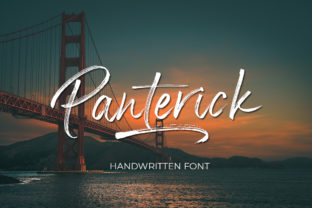
Panterick: A Bold Handwritten Font
Panterick is a confident, expressive handwritten font—crafted with deliberate strokes, subtle texture, and rhythmic variation. It’s not just “script” or “casual.” It carries presence. Letters lean with intention, terminals flare with quiet energy, and spacing breathes like real handwriting. That authenticity isn’t accidental—it’s built into every glyph.
Why Panterick Feels Different
Most handwritten fonts either soften edges to feel safe—or exaggerate quirks to feel playful. Panterick sits somewhere in between: grounded but lively, legible but personal. Its uppercase letters have strong verticals and generous curves; lowercase characters flow without collapsing into illegibility at smaller sizes. There’s no forced irregularity—just thoughtful imperfection, like ink pressed with consistent pressure on quality paper.
That balance makes it unusually versatile. You’ll find it working quietly on a teacher’s classroom poster, standing out on a boutique coffee bag, or anchoring the hero section of a freelance designer’s portfolio site—all without needing heavy tweaks or workarounds.
For Beginners and Hobbyists
If you’re just starting with design tools—whether Canva, Google Slides, or even PowerPoint—you’ll appreciate how Panterick adds polish without complexity. It installs like any other font, works in most apps that support OpenType, and doesn’t require ligature toggles or stylistic sets to look right. No tutorials needed. Just type, adjust size, and go.
Think: a handmade greeting card for a friend’s birthday, a printed recipe card for your kitchen wall, or a simple Instagram Story graphic for your weekend pottery class. Here, Panterick’s value is in its immediate impact—no learning curve, no overthinking.
For Educators and Content Creators
Educators often need fonts that feel warm and human—not sterile—but still hold up under repeated use. Panterick reads clearly on projectors and tablets, and its friendly tone helps soften dense material: think vocabulary posters, student feedback handouts, or weekly newsletter headers. It signals “this matters, and so do you.”
Bloggers and course creators use it similarly—to introduce modules, highlight key takeaways, or brand downloadable worksheets. Because it’s distinct but not distracting, readers stay focused on content, not font novelty.
For Freelancers and Design Professionals
Designers care about typographic nuance—and Panterick delivers it. Its letterforms avoid cliché while staying accessible. That means clients rarely say, “Can we make it less ‘handwritten’?” because it doesn’t scream “craft fair.” Instead, it reads as intentional, considered, and confident.
You might pair it with a clean sans-serif (like Inter or Lato) for contrast in branding systems—or layer it subtly behind watermarked textures for editorial layouts. Its OpenType features include standard ligatures and alternate characters, giving experienced users room to refine without overcomplicating.
For Small Business Owners and Marketers
When your brand voice leans toward sincerity—not slickness—Panterick supports that without leaning into trendiness. A local florist uses it on gift tags and email headers. A wellness coach applies it to workshop handouts and social bios. A small press chooses it for book cover accents and author bios.
It’s not a “logo font” by default—but it *works* where personality matters more than precision. And because it’s available with commercial licensing, there’s no surprise audit risk when scaling from Instagram posts to printed packaging.
Practical Considerations—Not Just Aesthetics
Before choosing Panterick, consider what your project truly needs:
- Ease of use: Installs and runs smoothly across Mac, Windows, and web platforms. No special software required.
- Legibility: Holds up well at 16–24pt in digital interfaces and 28–48pt in print—ideal for headlines, quotes, and short statements. Less effective for long paragraphs or tiny captions.
- Flexibility: Works across contexts—from minimalist stationery to layered editorial spreads—but shines brightest when given breathing room and thoughtful pairing.
- Commercial safety: Comes with clear licensing terms. Personal use is often free; commercial projects require a one-time license—transparent, no subscriptions.
- Creativity support: Its rhythm invites experimentation—not just with color or scale, but with negative space, texture overlays, and selective bolding.
When Panterick Fits—and When It Might Not
Panterick fits best when your goal is to signal warmth, authenticity, or approachability—without sacrificing clarity or professionalism. It’s ideal for projects where the feeling of the text matters as much as the words themselves.
It may not be the right choice if you need ultra-narrow widths for tight layouts, multilingual support beyond basic Latin characters, or extreme scalability (e.g., billboards or tiny app icons). And if your brand voice is strictly technical, futuristic, or highly structured—think fintech dashboards or engineering manuals—Panterick’s expressive nature could feel misaligned.
Real-World Examples Across Contexts
- A freelance illustrator uses Panterick for signature-style credits on commissioned prints—adding signature-like weight without tracing actual handwriting.
- A nonprofit organizer applies it to event flyers and donation appeal headers—making urgent messages feel personal, not transactional.
- A high school art teacher embeds it in rubrics and critique guides—helping students see assessment as supportive, not intimidating.
- A podcast host selects it for episode title cards and merch designs—reinforcing their conversational, human-centered tone.
- A small-batch candle maker prints it directly onto soy-wax labels—its texture complements tactile materials naturally.
None of these uses demand mastery of typography. Each relies instead on Panterick’s inherent ability to carry meaning through form—not just function.
Ultimately, choosing Panterick isn’t about chasing a trend. It’s about matching a tool to your intent: to connect, to clarify, to invite. Whether you’re typing a note to a student, designing a client’s launch campaign, or printing your first zine—you’re not just selecting a font. You’re choosing how your message lands. And with Panterick, it lands with quiet confidence.