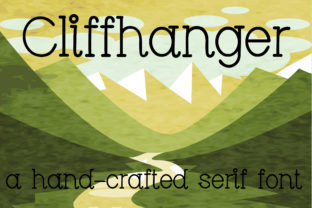
Cliffhanger: A Friendly Serif with Personality
If you’ve ever scrolled through a font library and paused at one that feels both classic and quietly playful, you’ve probably met Cliffhanger. It’s a serif typeface designed with warmth and intention—not stiff or overly formal, but grounded, readable, and full of subtle charm. Its most endearing feature? Those cute hooked tails on letters like g, y, and j. They’re not exaggerated or cartoonish—just gentle, confident curves that give the font a soft, human rhythm.
What Makes Cliffhanger Stand Out (Without Shouting)
Unlike many serifs built for authority or austerity, Cliffhanger balances structure with friendliness. Its letterforms have moderate contrast between thick and thin strokes—enough to feel refined, but not so much that it loses warmth at small sizes. The spacing is generous, the x-height is comfortable, and the terminals (the ends of strokes) are softly rounded—not blunt, not flared, just right for extended reading.
It’s the kind of font that works well when you want to signal thoughtfulness without sounding academic, or approachability without sacrificing polish. Think of it as the visual equivalent of a calm, articulate voice in a room full of loud design trends.
Where Cliffhanger Fits Naturally
You don’t need a branding agency or a design degree to get value from Cliffhanger. Here’s where it shines in everyday use:
- Small business websites and menus—its clarity helps customers scan offerings quickly, while the hooked tails add a touch of local character (perfect for cafés, boutiques, or studios).
- Educational handouts and workshop slides—readable at a glance, friendly enough to ease learning anxiety, and professional enough for school or community settings.
- Blog headers and newsletter subject lines—it stands out in inboxes without looking aggressive or overdesigned.
- Printed materials like greeting cards or zines—the subtle personality comes through beautifully on paper, especially when paired with simple layouts.
One practical note: because of its open shapes and balanced proportions, Cliffhanger performs well across devices. It holds up nicely on mobile screens—even at 16px body text—without losing legibility or its quiet charm.
Meet Clifford: The Script Sibling You’ll Want to Pair With It
Cliffhanger has a natural counterpart: Clifford, her sister script font. Where Cliffhanger grounds your layout with structure and rhythm, Clifford adds movement and warmth—think handwritten headings, short quotes, or decorative accents. Her strokes flow with confidence, and she shares the same underlying sensibility: elegant but never fussy, distinctive but never distracting.
Using them together creates visual harmony without monotony. Try Cliffhanger for body text and subheads, and Clifford for pull quotes or logo lockups. No forced contrast—just complementary voices in the same typographic family.
Realistic Things to Keep in Mind
Like any well-designed tool, Cliffhanger isn’t meant to solve every problem—and that’s part of its strength. Here’s what helps it land well:
- It’s not a display-only font. While it has presence, it’s built for readability first. Avoid stretching it too large without adjusting line height or letter spacing—it can feel heavy if overscaled without breathing room.
- It pairs best with clean, neutral companions. Try it alongside sans-serifs like Inter, Lato, or even a restrained geometric like Poppins. Avoid pairing it with other high-contrast serifs or overly decorative scripts—Clifford is the exception, not the rule.
- Its personality is subtle—not flashy. If you’re aiming for bold, dramatic impact (like a concert poster or luxury ad), Cliffhanger may feel too understated. That’s not a flaw; it’s intentional design alignment.
- Licensing matters. Check usage rights before using Cliffhanger in client work, apps, or merchandise. Some versions support web use with variable weights; others are desktop-only. When in doubt, refer to the foundry’s license or contact them directly.
Getting Started Is Simpler Than You Think
You don’t need to overhaul your entire design system to try Cliffhanger. Start small:
- Pick one recurring element—like email newsletter headers—and swap in Cliffhanger for a week. Notice how it changes tone without changing meaning.
- Use it for a single printed page: a workshop agenda, a recipe card, or a thank-you note. Print it, hold it, read it aloud. See how the hooked tails guide your eye—and how the rhythm feels in your own voice.
- Experiment with weight contrast: pair regular Cliffhanger body text with bold for subheads, then try adding a light italic for emphasis. Its range supports nuance, not just hierarchy.
And if you find yourself smiling at the tail of a lowercase y, you’re already connecting with what makes this font special—not just how it looks, but how it feels to use.
Why This Kind of Thoughtful Design Matters
In a world saturated with templates, auto-generated layouts, and algorithm-driven fonts, choosing something like Cliffhanger is a quiet act of intention. It says: I care how this reads. I care how it feels to someone scrolling, skimming, or sitting down to read carefully.
That intention shows up in trust—whether you’re a teacher sharing resources, a freelancer pitching services, or a small shop owner updating your website. Readers may not name the font, but they’ll sense the care behind the choice. And that builds connection far more reliably than novelty ever could.
So whether you're building your first portfolio site or refining your brand voice for the fifth time, Cliffhanger offers something rare: consistency with character, professionalism with personality, and typography that serves people—not just pixels.