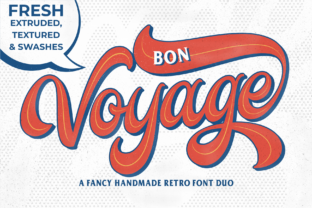
Bon Voyage Duo: Where Retro Craft Meets Modern Design Workflow
Typography is no longer just about legibility—it’s about voice, vibe, and intention. In a digital landscape saturated with sleek sans-serifs and algorithmically optimized fonts, designers, marketers, and small business owners are increasingly turning to expressive, human-made typefaces that carry personality without sacrificing usability. Enter Bon Voyage Duo: a carefully crafted font duo inspired by the warmth of 1970s handlettering, energized with playful pop sensibility, and engineered for today’s hybrid creative workflows.
More Than Nostalgia—A Thoughtful Evolution in Handmade Type
Retro-inspired fonts have seen renewed interest—not as novelty throwbacks, but as strategic tools. Unlike generic “vintage” fonts that rely on distressed textures or forced imperfection, Bon Voyage Duo draws from authentic mid-century lettering traditions: fluid curves, confident strokes, subtle asymmetry, and intentional rhythm. What sets it apart is its layered construction—each glyph built with precision across multiple visual layers, enabling rich texture and depth while remaining fully scalable and crisp at any size.
This isn’t mimicry; it’s reinterpretation. The designers didn’t just scan old signage or trace vintage posters. They studied how letterforms moved through space in analog contexts—chalkboard menus, concert posters, boutique packaging—and translated that kinetic energy into OpenType-ready outlines. The result? A font that feels handmade but performs like a professional-grade tool.
Designed for Real Workflows—Not Just Aesthetic Moments
Today’s creators rarely work in one environment. A social media manager might draft copy in Google Docs, design a Canva post for Instagram, then refine a brand guideline PDF in Adobe Illustrator. Bon Voyage Duo bridges those gaps intentionally. Its basic character set works instantly in browser-based editors like Canva, Figma, or Visme—no installation needed if using web fonts, and minimal setup for uploaded TTF/OTF files. You’ll see immediate impact: bold headlines with organic weight shifts, charming alternates that appear automatically with ligature support, and consistent spacing that avoids manual kerning fixes.
But for deeper control—custom swashes, stylistic sets, contextual alternates, or multilingual glyphs—the full OpenType feature set shines in desktop software like Adobe Illustrator, Photoshop, or Affinity Designer. These aren’t “bonus” features; they’re workflow accelerators. For example, a wedding stationery designer can cycle through three distinct ampersand styles with one click, or a café owner launching seasonal menus can swap between uppercase-only display variants and lowercase-friendly body options—all without switching fonts or editing outlines manually.
Why Handmade Fonts Are Gaining Ground—Beyond Aesthetics
The rise of handmade typography reflects broader shifts in how people relate to digital content. Consumers respond more authentically to visuals that signal care, individuality, and human intention. Algorithm-driven uniformity—while efficient—can feel distant or transactional. A well-placed, thoughtfully designed font like Bon Voyage Duo subtly communicates that someone paid attention: to tone, to audience, to context.
This matters especially for service-based professionals and small brands. A freelance illustrator using Bon Voyage Duo for their portfolio headline doesn’t just signal “I like retro”—they signal craftsmanship, attention to detail, and alignment with clients who value authenticity over polish-for-polish’s-sake. Similarly, an educator designing workshop handouts gains instant visual warmth and approachability, helping complex ideas land more gently.
Practical Use Cases Across Roles
- Bloggers & Content Creators: Use the upright, slightly condensed version for article headers that stand out in crowded feeds—without clashing with body text in system fonts like Inter or Lora.
- Local Businesses: A neighborhood bookstore or vinyl shop can apply the script variant to window decals or event banners, reinforcing identity without needing custom illustration.
- Educators & Coaches: Create visually cohesive slide decks where key takeaways use expressive caps, while supporting text remains clean and accessible—no design degree required.
- Product Packaging Designers: Leverage layered glyphs to simulate hand-inked texture on sustainable labels, avoiding raster-based effects that don’t scale or print cleanly.
What Makes Bon Voyage Duo Stand Out in a Crowded Market?
Not all handmade fonts deliver on both expression and efficiency. Some prioritize quirk over clarity; others sacrifice flexibility for consistency. Bon Voyage Duo balances these needs through deliberate design decisions:
- Intelligent layering: Each letter includes base, shadow, and highlight outlines—separable or combinable—so you can adjust depth or color independently, ideal for mockups or animated social posts.
- Extensive glyph coverage: Beyond standard Latin characters, it supports extended diacritics, fractions, ordinals, and stylistic alternates—making it viable for bilingual projects or nuanced editorial work.
- Optimized for speed: No excessive anchor points or unstable paths. It loads quickly in web environments and renders smoothly in print, even at small sizes (e.g., fine print on product tags).
- Consistent yet varied: Letterforms share core proportions and stroke logic, so mixing uppercase, lowercase, and script elements feels intentional—not jarring.
Getting Started—Without Overcomplicating Things
You don’t need to master OpenType features to benefit from Bon Voyage Duo. Start simple: install the font family, open Canva, and type a headline. Notice how the default settings already introduce subtle rhythm—how the “g” has a distinctive tail, how the “a” opens wide and friendly. That’s intentional design doing quiet work.
When you’re ready to go deeper, explore what your software supports. In Illustrator, enable “Contextual Alternates” in the Character panel to unlock automatic flourishes. In Photoshop, try applying layer styles *only* to the shadow outline for dimensional effects. In Figma, use variable instances to test weight shifts before finalizing layouts.
And remember: pairing matters. Bon Voyage Duo thrives alongside neutral, highly legible companions—think geometric sans-serifs like Poppins or humanist options like Nunito. Avoid competing decorative fonts; let Bon Voyage Duo be the voice, not the chorus.
A Font That Grows With Your Practice
Design tools evolve. Trends shift. Client needs change. A font collection shouldn’t require constant replacement—it should deepen in utility over time. Bon Voyage Duo was built with that longevity in mind: flexible enough for a quick Instagram story, robust enough for a multi-page brand identity system, expressive enough for personal projects, and precise enough for commercial licensing.
It reflects a growing preference among professionals—not for “trendy” fonts, but for ones with clear lineage, transparent intent, and tangible performance benefits. Whether you’re refreshing a Shopify banner, designing a conference badge, or illustrating a children’s book cover, Bon Voyage Duo offers craft without compromise, character without clutter, and ease without oversimplification.
In an era where attention is scarce and authenticity is currency, choosing the right typeface is one of the most grounded creative decisions you can make. And sometimes, the most effective statement isn’t loud—it’s warm, considered, and unmistakably human.