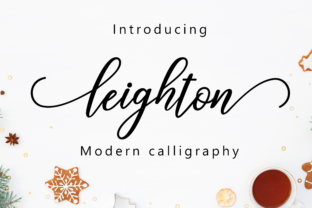
Leighton: Where Timeless Elegance Meets Contemporary Clarity
Leighton isn’t just another font release—it’s a quiet but confident response to how we communicate today. Designed with precision and restraint, Leighton is a beautiful and elegant font with a distinctly modern and contemporary twist. It balances warmth and structure, softness and clarity, tradition and forward motion. That balance is why designers, marketers, educators, and small business owners are choosing it—not as a stylistic flourish, but as a functional tool that supports meaning, builds trust, and reflects intention.
What Makes Leighton Stand Out in a Crowded Typography Landscape
Typography choices have never been more consequential—or more visible. With digital interfaces dominating how people read, learn, shop, and connect, typefaces carry subtle but powerful signals about credibility, care, and context. Leighton stands apart not through novelty for its own sake, but through considered detail: open apertures for improved legibility on screens, generous x-heights that maintain readability at smaller sizes, and carefully tuned letter spacing that breathes without sacrificing rhythm. Its curves feel human—not overly mechanical, not artificially whimsical—but quietly assured.
Unlike fonts that lean heavily into either stark minimalism or nostalgic ornamentation, Leighton occupies a nuanced middle ground. Its lowercase a and g nod gently to classic serif proportions, while its clean terminals and consistent stroke contrast align firmly with current UI and editorial standards. That duality makes it unusually versatile: equally at home in a university course syllabus, a boutique brand’s product packaging, or the dashboard of a SaaS platform built for professionals who value both aesthetics and efficiency.
Why Designers—and Their Clients—are Turning to Thoughtful Typography
There’s been a quiet shift in how typography is evaluated—not just by designers, but by stakeholders across industries. A startup founder no longer asks only, “Does this look good?” They ask, “Does this help users understand faster? Does it reflect our values without sounding pretentious? Can it scale across email, print, video captions, and mobile notifications without losing coherence?”
Leighton answers those questions with consistency. Its optical sizing variants—designed specifically for text, display, and interface use—mean you’re not stretching one weight across contexts where it wasn’t intended. That reduces visual fatigue and strengthens message retention. For educators building online learning modules, that means students stay engaged longer. For freelancers pitching to clients, it means their portfolio feels polished without needing extensive custom styling. For local businesses updating their signage or social media graphics, it means professionalism emerges naturally—not through expensive design overhauls, but through intentional, accessible choices.
How Leighton Fits Into Evolving Creative Workflows
Modern creative work rarely happens in isolation. Teams collaborate across tools—Figma for interface design, Notion for project briefs, Canva for quick social assets, Adobe Creative Cloud for final production. Leighton’s availability across major platforms (with robust web font support and variable font options) means it travels well. You can set a paragraph style in Figma using Leighton Text, export a PDF report from Notion that preserves the same typographic hierarchy, and drop the same font family into a WordPress theme without performance trade-offs.
This interoperability matters because time is the most constrained resource for creators. When a font works reliably across environments—without requiring workarounds, fallbacks, or manual kerning adjustments—it becomes infrastructure, not decoration. Leighton’s OpenType features (like discretionary ligatures, true small caps, and contextual alternates) are accessible but never intrusive. They enhance rather than distract—ideal for writers crafting newsletters, marketers preparing campaign decks, or podcasters designing episode thumbnails where every pixel carries weight.
Real-World Applications Across Roles
- Bloggers and content creators: Leighton’s readability at body text sizes (16–18px) supports long-form engagement—especially important as attention spans fragment and readers scan before committing. Its subtle personality helps differentiate voice without competing with content.
- Educators and trainers: In slide decks or LMS interfaces, Leighton improves information hierarchy. Headings stand out with quiet authority; bullet points remain scannable without visual noise.
- Small business owners: Whether printing business cards or designing Instagram Stories, Leighton delivers cohesion. Its balanced weight distribution ensures legibility even on lower-resolution prints or compressed mobile images.
- Product managers and UX writers: Microcopy—button labels, error messages, tooltips—benefits from Leighton’s clarity. Its neutral-yet-warm tone conveys helpfulness without sounding robotic or overly casual.
Not Just Aesthetic—A Practical Response to Changing Expectations
User expectations have evolved alongside technology. People don’t just want fast loading pages—they want pages that feel *considered*. They notice when line height is cramped, when contrast is insufficient, when type feels arbitrary rather than intentional. Leighton was developed with those expectations in mind: WCAG-compliant contrast ratios out of the box, responsive behavior in fluid layouts, and character sets that support multilingual content without switching families.
This isn’t about chasing trends—it’s about meeting real needs. As remote work normalizes hybrid communication (video calls, async docs, shared whiteboards), consistency across mediums builds continuity and reduces cognitive load. When your team uses Leighton in internal documentation *and* customer-facing materials, there’s an unspoken alignment—a shared visual language that reinforces reliability.
Choosing Leighton Isn’t About Following a Style—It’s About Supporting Your Intent
Typography doesn’t exist in a vacuum. It serves purpose: to inform, persuade, guide, comfort, or inspire. Leighton’s strength lies in how gracefully it adapts to those purposes without demanding attention for itself. It won’t shout. It won’t distract. But it will elevate—whether you’re launching a new service, redesigning a curriculum, or simply sending a thoughtful email to a client.
That’s why professionals increasingly treat font selection as part of strategy, not styling. It’s not about finding the “most unique” option—it’s about finding the one that sustains clarity, invites reading, and remains legible across devices, lighting conditions, and user abilities. Leighton does that without compromise.
A Few Practical Recommendations
- Start with hierarchy, not decoration: Use Leighton Text for body copy and Leighton Display for headlines—not because they’re “prettier,” but because each was engineered for its role. This avoids common readability pitfalls like overly tight tracking in small text or weak contrast in large sizes.
- Test in context: Preview Leighton in your actual environment—on a phone screen, in a printed mockup, embedded in a newsletter template. See how it behaves with your brand colors and imagery before finalizing.
- Leverage its neutrality wisely: Because Leighton doesn’t impose strong personality, pair it intentionally. A warm sans-serif for buttons or captions can complement its elegance without clashing. Avoid pairing it with highly decorative or distressed fonts—its strength is in quiet confidence, not contrast-driven drama.
- Consider accessibility early: Enable variable font axes (like weight and width) where supported. Use semantic HTML headings paired with Leighton’s optical sizing to ensure screen readers and browsers interpret structure correctly.
Leighton represents a broader movement—not toward flashier fonts, but toward more responsible, human-centered typography. It reflects a growing understanding that sophistication isn’t found in complexity, but in refinement; that elegance isn’t ornamental, but functional. When you choose Leighton, you’re not just selecting a typeface—you’re affirming a commitment to clarity, consistency, and care in how ideas move from your mind to someone else’s understanding.