Khalid: A Luxurious Handwritten Font for Modern Design
When your brand or project needs warmth, personality, and quiet sophistication—without sacrificing clarity or contemporary appeal—Khalid stands out. It’s not just another script font. It’s a carefully crafted, luxurious handwritten typeface designed for real-world use: from a photographer’s subtle watermark to a boutique’s elegant product label, from a wedding invitation that feels personal to a social media post that stops the scroll.
Why Khalid Feels Different—And Why That Matters
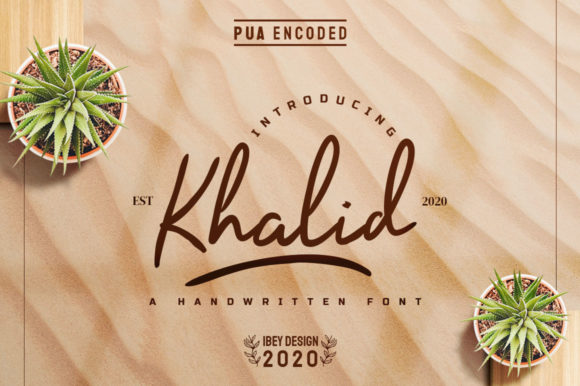
Many handwritten fonts lean too casual, too ornate, or too inconsistent to scale across formats. Khalid bridges that gap. Its modern style avoids dated flourishes while retaining organic rhythm—each letter flows with intention, not randomness. The contrast between thick and thin strokes is refined, not exaggerated; spacing is generous, never cramped. That balance makes it legible at small sizes (think business cards or packaging labels) and impactful at large ones (billboards, hero banners, or signage).
The inclusion of both regular and swash versions is where Khalid becomes especially practical. You’re not choosing between “functional” and “decorative”—you’re gaining flexibility. Use the regular version for body text in an email newsletter or caption overlay; switch to swash for a headline, monogram, or logo lockup. This duality supports consistent branding while allowing expressive variation—no need to juggle multiple unrelated fonts.
Real Uses—Where Khalid Delivers Tangible Value
Photographers and visual creators often struggle with watermarks that either vanish into the image or overwhelm it. Khalid’s slender yet confident stroke weight ensures visibility without intrusion—especially when set in light gray or muted gold against a neutral background. Its natural flow also complements portrait or lifestyle photography better than rigid, geometric scripts.
Small business owners and makers benefit most when time is scarce and design skills vary. With Khalid, a handcrafted look doesn’t require illustration expertise. A café owner can pair it with a clean sans-serif (like Inter or Montserrat) to design a seasonal menu, loyalty card, or Instagram Story highlight cover—all in under 20 minutes. The font’s built-in alternates and ligatures (accessible via OpenType features) add polish automatically—no manual tweaking needed.
Wedding professionals and event designers rely on tone as much as typography. Khalid conveys intimacy and care without veering into cutesy or overly formal territory. It works equally well for digital RSVPs, printed ceremony programs, or acrylic table numbers. Because its swash characters include graceful entry and exit strokes, initials or monograms gain presence without looking forced.
Marketers and content creators know that social feeds reward authenticity. A branded quote graphic using Khalid feels human—not templated. Unlike many script fonts, it holds up in vertical video formats (Reels, Shorts, TikTok) where tight cropping and fast pacing demand clarity. Try pairing it with a subtle texture overlay or soft shadow for depth, then animate just the letters’ entrance—simple, but distinct.
Who Benefits Most—and When to Consider Alternatives
Khalid serves creators who value intentional elegance: freelancers building client portfolios, educators designing classroom resources with warmth, bloggers curating newsletters that feel like letters, or indie publishers crafting book covers with tactile appeal. It’s especially strong for B2C contexts where emotional resonance matters—beauty brands, artisan goods, wellness services, or creative studios.
That said, Khalid isn’t ideal for every scenario. It’s not designed for long-form body text—its handwritten nature would fatigue readers in paragraphs. Avoid using it for legal disclaimers, technical documentation, or multilingual interfaces requiring extensive character sets (it supports Latin-based languages well, but lacks extended Cyrillic or Asian language support). If your project demands high accessibility compliance (e.g., government or educational platforms), pair Khalid only for headings and decorative elements—not primary UI text.
Practical Tips for Getting the Most From Khalid
- Start simple: Use the regular version first—set it at 24–36pt for headlines, 14–18pt for short captions. Let the swash version earn its place as an accent, not default.
- Pair thoughtfully: Pair with neutral, highly legible sans-serifs (e.g., Manrope, Work Sans) or low-contrast serifs (Cormorant Garamond). Avoid competing scripts or overly decorative companions.
- Leverage OpenType features: In design apps like Adobe Illustrator or Affinity Designer, enable stylistic sets to access alternate glyphs—especially useful for avoiding repeated letter combinations (like “ll” or “ff”) that can look awkward in handwriting.
- Test across mediums: Preview how Khalid renders on mobile screens, printed labels, and dark-mode interfaces. Its light weight may need slight tracking adjustment or a subtle stroke effect in certain contexts.
- Respect hierarchy: Use size, weight (via layering or faux-bold sparingly), and color—not just font choice—to signal importance. Khalid’s strength is voice, not structure.
A Font That Supports Your Goals—Not Just Your Aesthetics
Design choices shape perception before a single word is read. Khalid doesn’t shout—it invites. It doesn’t mimic handwriting; it interprets its best qualities: confidence, nuance, and quiet refinement. That makes it valuable not just for what it looks like, but for what it helps you achieve: stronger audience connection, faster design decisions, cohesive cross-platform expression, and work that feels unmistakably yours.
If you’ve spent hours searching for a script that balances artistry with usability—or avoided script fonts altogether because they felt unreliable—Khalid offers a grounded alternative. It’s not about trend-chasing. It’s about having a tool that adapts to your voice, not the other way around.
Whether you're refreshing a logo, designing a limited-edition product label, or creating a heartfelt invitation, Khalid gives you room to express warmth without compromise—and that’s rare in today’s fast-moving, often impersonal digital landscape.