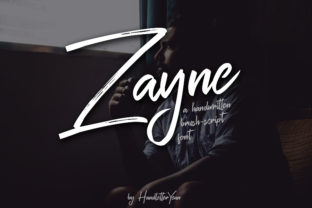
Zayne
Zayne isn’t just another script font—it’s a handwritten voice with attitude. Designed to feel fresh, urban, and unmistakably human, Zayne brings a handmade rhythm to digital design without sacrificing polish. It’s not overly ornate, nor is it sterile or generic. Instead, it strikes a rare balance: funky enough for streetwear branding, elegant enough for boutique wedding invites, and versatile enough to hold its own across screens, print, and motion graphics.
Where Zayne Fits in Real Life (Not Just Mockups)
Fonts live or die by how well they work where people actually use them—not in isolated type specimens, but on coffee sleeves, Instagram Stories, product tags, and tiny mobile buttons. Zayne shines where personality matters more than perfection.
Small Businesses Building Identity on a Budget
A local ceramicist launching her first online shop might spend hours choosing fonts that reflect her process—slow, tactile, intentional. Zayne’s subtle swashes and natural ligatures (like the flowing connection between “f” and “i” or “t” and “h”) mimic real pen-on-paper movement. That authenticity reads as trustworthy and grounded—especially when paired with clean sans-serif body text. It works beautifully for shop names, “hand-poured” labels, or limited-edition collection headers—without demanding custom illustration or calligraphy commissions.
Creative Freelancers Pitching With Personality
Designers, copywriters, and photographers often rely on self-promotion that stands out in crowded inboxes and feeds. A portfolio site using Zayne for section headlines (“Work,” “About Me,” “Let’s Connect”) adds warmth and distinction against standard system fonts. It signals craft—not just competence. One branding consultant told us she swaps Zayne in for client presentation covers when the brief calls for “approachable but elevated.” The result? Fewer “generic agency” assumptions, more “this person gets my audience.”
Event Planners & Wedding Designers Who Skip the Clichés
Gone are the days when every invitation had to whisper “vintage romance” in copperplate. Today’s couples want their stationery to feel like *them*—maybe they met at a vinyl shop, live in Brooklyn, and elope on a rooftop. Zayne delivers elegance with edge: think hand-lettered menu cards with a slight bounce, RSVP deadlines styled like a friendly note, or monogrammed napkins that look drawn—not digitized. Its built-in swashes add flair without looking forced, and because it’s designed with consistent spacing and weight, it remains legible even at smaller sizes (unlike some ultra-thin scripts that vanish on phone screens).
Digital Creators Adding Texture to Social Content
Instagram carousel slides, TikTok lower-thirds, Pinterest quote graphics—these spaces reward clarity *and* character. Zayne’s contrast between thick downstrokes and delicate upstrokes gives it presence at small sizes, while its organic rhythm prevents visual fatigue during quick scrolling. A food blogger uses it for recipe titles (“Smoked Harissa Chickpeas”) over moody flat-lays; a mindfulness coach applies it to affirmations (“You’re allowed to pause”) layered softly over nature footage. In both cases, the font supports tone—not overrides it.
Who Might Want to Think Twice Before Using Zayne?
Zayne is expressive—but expression has context. It’s not built for interfaces where speed and universal readability are non-negotiable. You wouldn’t use it for airport signage, medical dosage instructions, or dense legal disclaimers—and that’s by thoughtful design, not limitation. Its charm lives in moments of intention, not obligation.
Also worth noting: Zayne includes OpenType features like contextual alternates and discretionary ligatures. That means its full potential unlocks best in design apps that support them (Adobe Creative Cloud, Affinity Suite, Figma with proper font plugins). If you’re working in basic email builders or older CMS platforms, you’ll still get the core glyphs—but miss out on the subtle joins and flourishes that make it feel truly hand-drawn.
Pairing Zayne Thoughtfully (Not Just “Contrast”)
Good pairing isn’t about opposites—it’s about shared values. Zayne pairs naturally with humanist sans-serifs (like Inter, Manrope, or Clash Grotesk) that have warmth in their curves and open apertures. Avoid rigid geometric fonts (think early 2000s tech logos) unless irony is part of your brand voice—they clash tonally, not just visually.
For editorial layouts, try setting Zayne at 24–36pt for pull quotes or chapter openers, then stepping down to a highly legible serif (IBM Plex Serif, Charter) for body copy. The contrast feels intentional, not jarring—like a spoken phrase landing before calm narration resumes.
What Makes Zayne Feel “Handmade” Without Looking Rough?
It’s in the details: slight variations in stroke thickness, irregular baseline alignment that mimics natural hand movement, and terminals that taper—not snap—into endings. These aren’t flaws. They’re cues our eyes recognize as human-made. Unlike fonts that simulate “imperfection” with random noise or jitter, Zayne’s irregularities follow logic—so it feels alive, not accidental. That’s why it scales well: at 120pt on a mural, it pulses with energy; at 14pt on a tag, it still whispers care.
Practical Considerations Before Licensing
Zayne is available in both desktop and web font formats—with licensing tiers based on usage scope (e.g., single designer vs. entire studio, number of domains, or app installs). If you’re embedding it in a client’s Shopify theme or SaaS dashboard, confirm the license covers web use at that scale. Also check language support: Zayne covers Latin-based languages (English, Spanish, French, Portuguese, etc.) with full diacritic sets—but doesn’t include Cyrillic, Arabic, or East Asian glyphs. That’s fine for most U.S./EU-focused projects, but crucial to verify if your audience spans broader regions.
When “Unique” Isn’t Enough—Why Zayne Stands Out
There are dozens of handwritten fonts labeled “elegant” or “modern.” What separates Zayne is restraint. It doesn’t over-swash. It doesn’t compress letters unnaturally for tight spacing. It doesn’t sacrifice legibility for flair. Instead, it offers nuance: a lowercase “g” with a soft, closed loop; an uppercase “Q” whose tail curls just shy of dramatic; a period that feels like a deliberate dot—not a pixelated afterthought.
That level of considered detail means Zayne doesn’t shout. It invites. And in a world saturated with algorithm-driven sameness, that quiet confidence is exactly what makes it memorable.