The Brandy Font
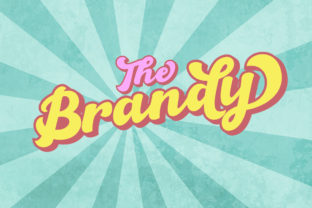
The Brandy is a bold script font designed with a handmade, retro aesthetic. It features irregular stroke widths, subtle texture, and expressive letterforms that evoke mid-century signage, vintage packaging, and hand-painted shop fronts. Unlike highly polished digital scripts, The Brandy intentionally retains organic imperfections—slight wobbles, uneven baselines, and variable spacing—that reinforce its analog character.
This typeface belongs to the display font category: it’s optimized for visibility and impact at larger sizes, not for extended reading. Its design prioritizes personality over neutrality, making it well-suited for contexts where visual tone and brand voice matter as much as legibility.
Why Designers Consider The Brandy
Designers often seek fonts like The Brandy when aiming to communicate authenticity, warmth, or nostalgic appeal. Its retro sensibility resonates in markets where heritage, craft, or local identity are central—think artisanal food brands, independent bookstores, boutique apparel labels, or small-batch beverage packaging. Because it carries strong stylistic associations, The Brandy helps establish mood quickly, reducing reliance on supporting imagery or color to convey tone.
It’s also frequently chosen for short-form applications: product labels, social media graphics, event posters, t-shirt prints, and quote-based visuals. In these cases, the font’s visual weight and distinct rhythm support immediate recognition—even at a glance or from a distance.
Key Benefits and Practical Strengths
One of The Brandy’s primary advantages is its high visual distinction. Among script fonts, it stands out for balancing boldness with approachability—neither overly formal nor excessively casual. Its handmade quality lends itself well to branding efforts seeking to signal human-scale production or personal connection.
From a production standpoint, The Brandy typically includes standard Latin characters, numerals, and basic punctuation. Most versions support OpenType features such as ligatures and alternate glyphs, allowing for subtle customization without requiring advanced typography knowledge. It scales effectively across print and digital formats when used appropriately—especially at sizes above 24pt for web or 12pt+ in high-resolution print.
Its retro styling also offers built-in versatility within certain palettes: it pairs naturally with earthy tones, muted pastels, or monochrome schemes. When combined with clean sans-serif companions (e.g., for body text or captions), it creates a balanced typographic hierarchy that feels intentional rather than arbitrary.
Tradeoffs and Important Considerations
The Brandy is not designed for readability at small sizes or in long passages. Its connected letters, variable spacing, and decorative flourishes reduce clarity in dense text blocks or low-resolution environments. Using it for website navigation menus, legal disclaimers, or multi-paragraph descriptions risks compromising usability and accessibility.
Licensing is another practical factor. While some vendors offer The Brandy under desktop-only licenses, others include web or app usage—often at different price points. Users should verify license scope before deploying it across platforms, especially in client work or commercial products.
Additionally, its strong stylistic voice means it may limit future design flexibility. A brand built heavily around The Brandy’s retro energy might find it challenging to pivot toward a more modern or minimalist direction later without a full visual rebrand. That doesn’t make it unsuitable—just worth acknowledging early in the decision process.
Situations Where The Brandy Is a Strong Fit
The Brandy excels in projects where the goal is to anchor a visual identity with clear emotional resonance. Examples include:
- Logo lockups for lifestyle brands emphasizing craftsmanship, nostalgia, or regional pride;
- Product packaging for coffee roasters, bakeries, or craft breweries seeking tactile, human-centered appeal;
- Event posters or promotional banners where headline impact matters more than fine detail;
- Merchandise like t-shirts or tote bags where typography serves as both graphic element and message;
- Social media assets—especially Instagram or Pinterest visuals—where composition favors bold, centered text over complex layouts.
In each case, success depends less on technical perfection and more on alignment between The Brandy’s expressive qualities and the audience’s expectations. A vintage record store targeting collectors will likely benefit more from its aesthetic than a fintech startup explaining API documentation.
When Alternatives May Be More Appropriate
Designers should consider alternatives if any of the following apply:
- Legibility is non-negotiable. For interfaces, signage with regulatory requirements, or multilingual content, a more neutral script—or a carefully paired serif/sans combination—may serve better.
- The project requires extensive typographic variation. The Brandy generally lacks extensive weights (e.g., light, medium, black) or italics. If a system needs multiple hierarchies or responsive scaling, a family with broader variants may be more sustainable.
- The brand voice leans toward precision, innovation, or global neutrality. Fonts with tighter spacing, uniform contrast, and restrained ornamentation often communicate those values more directly.
- Budget or licensing constraints limit usage scope. Some retro-style fonts come with restrictive licenses or lack web font options—making them impractical for dynamic sites or SaaS platforms.
Making an Informed Choice
Evaluating The Brandy isn’t about determining whether it’s “good” or “bad”—it’s about assessing fit. Start by clarifying the core purpose of the text: Is it meant to attract attention, reinforce brand character, or deliver information efficiently? Next, consider context: Where will it appear? At what size? Alongside what other visual elements? Who is the intended audience—and what associations do they likely bring to retro-inspired design?
Testing is essential. Render sample text in real conditions: on a mobile screen, printed at actual size, alongside brand colors and photography. Pay attention not just to how it looks, but how it functions—does it guide the eye appropriately? Does it support the message, or compete with it?
Finally, compare it against two or three alternatives—not just other scripts, but complementary pairings. A strong choice often emerges not from loving one font in isolation, but from recognizing how well it works within a broader system.
The Brandy is a deliberate tool—not a default. Its value lies in its specificity. When matched thoughtfully to intent, audience, and environment, it contributes meaningfully to visual communication. When applied without consideration for its constraints, it can undermine clarity or consistency. As with any typeface, its effectiveness depends less on inherent qualities and more on how intentionally it’s used.