Oldschool Tag
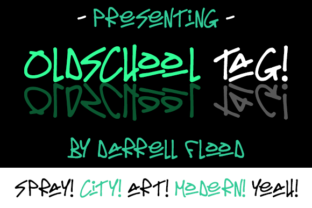
Oldschool Tag isn’t just another graffiti font—it’s a living echo of late-’80s and early-’90s street culture: loose, confident, slightly imperfect, and full of kinetic energy. Its looping connections, uneven baselines, and expressive swashes make it instantly recognizable in posters, apparel, murals, and digital campaigns rooted in urban authenticity. Whether you’re designing a local music festival flyer, branding a sneaker pop-up, or crafting social content for a streetwear label, Oldschool Tag delivers attitude without overcomplicating the message.
Why It Resonates—And Why That Can Be Misleading
Its appeal is real—but that doesn’t mean it’s universally appropriate. Many assume “graffiti style = edgy + attention-grabbing,” so they drop Oldschool Tag into headlines, logos, or even body text without considering context. That’s where things go sideways. Unlike clean sans-serifs built for readability at small sizes, Oldschool Tag thrives at scale and in motion: think 48pt on a brick wall, not 12pt in an email newsletter. Using it where legibility matters most—like navigation menus, legal disclaimers, or accessibility-driven interfaces—undermines both function and intent.
Mistake #1: Assuming All “Graffiti Fonts” Are Interchangeable
Not all tag-style fonts share Oldschool Tag’s rhythm or structural logic. Some rely heavily on ligatures; others lack consistent spacing or baseline alignment. When designers swap Oldschool Tag for a free “urban” font found via vague search terms like “cool graffiti font download,” they often get inconsistent kerning, missing glyphs (especially punctuation or accented characters), or no OpenType features at all. The result? A headline that looks unintentionally sloppy—not authentically raw.
Better approach: Test any alternative with your exact copy *before* finalizing. Type out your brand name, a short tagline, and one sentence with punctuation. Zoom to 100%—does the “&” sit awkwardly? Does the lowercase “g” clash with the next letter? If yes, keep looking. Oldschool Tag includes carefully tuned alternates and contextual ligatures; replicate that intentionality, not just the surface look.
Mistake #2: Ignoring Licensing for Real-World Use
Oldschool Tag is often available under multiple licenses—some permit web use only, others cover merchandise, app UI, or broadcast. A freelance designer once applied it to a client’s T-shirt line using a desktop-only license, triggering a quiet but costly takedown request months later. Similarly, embedding it in a WordPress theme sold to hundreds of users requires an extended license—not the standard one.
Better approach: Always check the license *before* mockup stage. Ask yourself: Will this appear on physical products? In video? As part of a SaaS dashboard? If the answer is yes to any, confirm the license explicitly permits it. Reputable sellers (like commercial foundries or verified marketplaces) list usage rights clearly—not buried in fine print. When in doubt, contact the vendor directly. It takes five minutes—and saves weeks of rework.
Mistake #3: Overlooking Technical Fit in Digital Environments
Oldschool Tag wasn’t designed for variable font axes or responsive scaling. On mobile, its intricate strokes can blur or pixelate if not served correctly. One small business owner used it in CSS @font-face without fallbacks or optimized WOFF2 files—so on older Android devices, browsers defaulted to Times New Roman mid-sentence. The contrast killed visual cohesion and weakened brand trust.
Better approach: Pair Oldschool Tag intentionally. Use it strictly for display: hero headers, poster titles, button labels with ample padding. For everything else—navigation, captions, forms—choose a highly legible, system-friendly companion (e.g., Inter, Manrope, or a well-hinted grotesk). And always serve it via modern, compressed formats with proper font-display: swap to avoid invisible text during load.
What to Check Before You Commit
- Character coverage: Does it include Latin Extended-A? Support for European diacritics? Basic currency symbols? If your audience includes Spanish, French, or Polish speakers, missing glyphs break communication—not just aesthetics.
- Weight consistency: Oldschool Tag typically ships as a single weight. Don’t expect Light, Bold, or Italic variants. If your design system relies on typographic hierarchy through weight shifts, plan how you’ll create contrast elsewhere—color, size, spacing, or layout.
- Rendering behavior: Test across Chrome, Safari, and Firefox—not just on Mac, but Windows and iOS. Some browsers handle overlapping paths in graffiti fonts less gracefully. A quick screenshot comparison reveals inconsistencies faster than any spec sheet.
- Design intent alignment: Ask honestly: Does my project celebrate craft, rebellion, or community? Or does it prioritize clarity, speed, or universal access? Oldschool Tag supports the former—but not the latter. Choosing it thoughtfully honors its roots *and* serves your audience better.
Using It Well Is About Restraint—Not Rules
You don’t need to master calligraphy to use Oldschool Tag effectively. You do need to respect its nature: it’s a spotlight, not a workhorse. Apply it where energy matters more than endurance—where viewers pause, lean in, and feel something before they read a word. That might be a mural’s focal point, a limited-edition vinyl sleeve, or the opening title of a documentary about Bronx hip-hop history.
When used with awareness—not just aesthetic impulse—it deepens authenticity instead of diluting it. It signals you understand the culture behind the curves, not just the trend. And that distinction? That’s what separates memorable work from forgettable noise.
So before you paste it into your next layout, ask: Is this where Oldschool Tag earns its place—or is it just filling space? The best designs answer that question before the first letter renders.