Latia Script: Elegant Handwriting for Modern Design
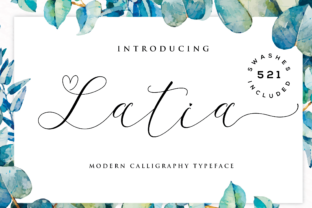
There’s a quiet power in handwriting — the subtle variation in stroke weight, the gentle rhythm of connected letters, the unmistakable sense of human presence. Latia Script captures that essence with remarkable fidelity, offering a digital typeface that feels authentically hand-drawn without sacrificing clarity or versatility. It’s not just another script font; it’s a carefully crafted tool that bridges warmth and professionalism — ideal when your message needs both personality and polish.
Why Latia Script Stands Out Among Script Fonts
Many script fonts lean too far into ornate flourishes or overly casual looseness, making them hard to read at smaller sizes or unsuitable for branding consistency. Latia Script avoids those pitfalls. Its letterforms balance graceful curves with clean, open counters and even spacing — ensuring legibility across contexts, from a tiny product label to a full-width social media banner. The lowercase ‘g’, ‘y’, and ‘f’ include subtle, intentional terminals that guide the eye smoothly, while uppercase letters retain dignity without stiffness.
This isn’t a decorative flourish you add at the end — it’s a foundational choice that shapes how your audience perceives tone before they read a single word. A wedding invitation set in Latia Script conveys thoughtfulness and care. A boutique skincare label using it signals artisanal quality and attention to detail. Even a LinkedIn post headline gains quiet authority — not flash, but confidence.
Where Latia Script Delivers Real Value
For small business owners and solopreneurs, time is finite and brand cohesion is non-negotiable. Latia Script works seamlessly across touchpoints: pair it with a neutral sans-serif (like Inter or Montserrat) for contrast, and you’ve got an immediate visual system for logos, email headers, packaging, and Instagram Stories — all unified by the same expressive voice. No need to commission custom lettering or juggle multiple fonts to “feel personal.” One well-chosen script does the work — consistently and elegantly.
Designers and marketers often face tight deadlines and evolving platforms. Latia Script scales cleanly across formats: it renders crisply on high-DPI screens, holds up in print at 8 pt for fine stationery, and remains distinctive even as a watermark over photography. Its OpenType features — including contextual alternates and ligatures — add nuance automatically, so “The” or “and” flow naturally without manual tweaking. That’s not just convenience; it’s fewer revision rounds and faster client approvals.
Wedding professionals and event planners know how much emotional resonance lives in typography. Latia Script’s warmth supports storytelling — whether it’s the couple’s names on a save-the-date, a handwritten-style menu card, or delicate foil-stamped details on premium invitations. Unlike ultra-thin scripts that risk disappearing on textured paper, Latia’s moderate contrast ensures ink coverage stays rich and tactile, especially in letterpress or thermography.
Practical Pairings and Layout Tips
Latia Script shines brightest when given room to breathe. Avoid cramming it into narrow columns or pairing it with other highly decorative fonts. Instead:
- Use it for headlines, quotes, or short phrases — never long paragraphs.
- Set body text in a highly legible sans-serif or serif (e.g., Lora, Source Serif Pro) to create clear visual hierarchy.
- In packaging design, apply it to front-facing elements only — the brand name, tagline, or flavor descriptor — letting supporting copy remain functional and scannable.
- For social media, test readability at thumbnail size: if the script becomes a blur, simplify — use just the first word or initials in Latia, then continue in a supporting font.
Its lowercase-only version (often included in the family) is especially effective for subtle branding — think watermarks on portfolio images or minimalist return address labels. There, its intimacy feels intentional, not incidental.
Who Might Want to Look Elsewhere?
Latia Script excels where elegance and approachability matter — but it’s not universal. If your brand voice is bold, industrial, or tech-forward (think cybersecurity SaaS or athletic wear), its softness may dilute impact. Similarly, for multilingual projects requiring extensive diacritics or non-Latin scripts, verify language support: Latia Script covers Western European languages thoroughly, but doesn’t extend to Cyrillic, Greek, or extended Vietnamese glyphs.
And while it’s versatile, it’s not a substitute for custom lettering in high-stakes identity work — like a global luxury brand launching a new flagship product. In those cases, Latia Script can still serve as a strong starting point for mood boards or early mockups, helping stakeholders align on tone before investing in bespoke development.
Thoughtful Use Beyond Aesthetics
Typography influences perception more than many realize. Studies in cognitive psychology suggest that script fonts — when used appropriately — increase perceived sincerity and effort. That matters when you’re asking someone to trust your service, invest in your product, or celebrate a milestone with you. Latia Script doesn’t shout; it invites. It says, “I took time to get this right.”
That intentionality extends to accessibility. While no script font meets WCAG AA contrast requirements for body text, Latia Script’s generous x-height and distinct letter shapes improve recognition for readers with mild dyslexia — especially compared to tightly spaced or excessively stylized alternatives. When used responsibly (i.e., as display text only, with sufficient contrast and size), it supports inclusive communication without compromising beauty.
Photographers and content creators also find value in its adaptability as a watermark. Unlike blocky or generic fonts, Latia Script integrates gracefully into lifestyle imagery — visible enough to protect work, yet refined enough not to distract from the subject. Its natural rhythm mirrors the organic flow of light and composition, reinforcing rather than competing with the image.
Making It Work for Your Workflow
Most users license Latia Script via reputable foundries or marketplaces that provide OTF/TTF files, webfont kits (WOFF2), and basic licensing guidance. For WordPress or Shopify sites, embed the webfont using @font-face or platform-native tools — just ensure fallbacks are defined so headings remain readable if loading fails.
If you're using Figma, Adobe Creative Cloud, or Affinity apps, install the desktop version first. Then leverage character styles and text presets to maintain consistency — for example, saving “Latia Script Bold, 36pt, #2D2D2D” as a reusable heading style. That small step prevents accidental size or weight variations across dozens of social assets or presentation slides.
Finally, remember: the strongest use of Latia Script isn’t about showing off the font — it’s about serving the message. Let it elevate, not dominate. A single line of text in Latia Script on a clean white label communicates more than three lines of dense, generic type ever could.