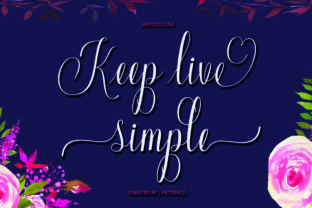
Keep Live Simple Font
Keep Live Simple is a handwritten display font designed with organic flow and intentional contrast. It features natural stroke variation, subtle irregularities, and a confident bold weight that distinguishes it from lighter, more delicate script fonts. While rooted in handwriting aesthetics, its structure prioritizes legibility at larger sizes—making it suitable for headings, logos, packaging, and short-form typographic statements.
Why Designers Consider Keep Live Simple
Designers often seek typefaces that convey warmth, authenticity, or approachability without sacrificing visual impact. Keep Live Simple meets this need by balancing expressive character with functional clarity. Its bold twist adds presence, helping text stand out in digital banners, social media graphics, or printed product labels where attention is fleeting. Unlike many script fonts that rely heavily on flourishes or tight letter spacing, Keep Live Simple maintains generous counters and open apertures—supporting readability across devices and viewing distances.
It’s especially relevant for projects emphasizing craftsmanship, wellness, lifestyle, or personal branding—contexts where typography contributes meaning beyond mere legibility. For example, a small-batch soap label, a yoga studio’s website banner, or an independent author’s book cover may benefit from the human touch Keep Live Simple provides.
Practical Benefits and Realistic Expectations
One key benefit is its versatility within its intended use case: display typography. The font includes standard Latin characters, numerals, and basic punctuation. Its bold weight ensures strong contrast against light or muted backgrounds, reducing the need for outlines or shadows to enhance visibility. Because it avoids extreme thin-to-thick transitions, it scales well from 36pt to 120pt without losing integrity.
However, expectations should align with its design scope. Keep Live Simple is not a text font. It lacks extended language support (e.g., Cyrillic, Greek, or extensive diacritics), making it unsuitable for multilingual interfaces or long-form editorial layouts. It also doesn’t include stylistic alternates, ligatures, or multiple weights—so designers seeking typographic hierarchy through weight contrast must pair it thoughtfully with a complementary sans serif or slab serif.
Another consideration is licensing. Like most premium handwritten fonts, Keep Live Simple is typically distributed under desktop and webfont licenses with usage limits. Users deploying it on high-traffic websites or in client work should verify license terms—particularly around embedding, redistribution, and commercial scope—to avoid compliance issues.
When Keep Live Simple Fits Well
Keep Live Simple works best when the goal is to communicate sincerity and intentionality in a compact typographic element. It shines in contexts where:
- A single headline or logo requires emotional resonance without appearing overly casual;
- Brand identity leans into artisanal, mindful, or nature-inspired values;
- Design systems already include a clean, neutral supporting typeface for body text;
- Projects are print- or screen-based but not highly interactive (e.g., static landing pages, posters, merch, or email headers);
- Time or budget constraints favor a ready-made solution over custom lettering.
In these cases, Keep Live Simple reduces decision fatigue while delivering consistent visual tone. Its distinct rhythm helps differentiate a brand from competitors using generic sans serifs or overused script fonts.
When Alternatives May Be More Appropriate
Keep Live Simple is less ideal when flexibility, scalability, or linguistic breadth is required. For instance:
- Long-form content: If a project involves paragraphs of body copy—even in marketing emails or blog posts—a dedicated text font will perform better in terms of readability, tracking, and hyphenation control.
- Dynamic interfaces: Applications with user-generated text, form inputs, or responsive navigation menus need fonts with robust OpenType features and broad character sets—capabilities outside Keep Live Simple’s scope.
- Global audiences: Projects targeting non-English-speaking users may require fallbacks or entirely different type families to ensure accurate rendering and cultural appropriateness.
- Strict brand guidelines: Organizations with established typography systems may find Keep Live Simple difficult to integrate without disrupting existing hierarchy or voice consistency.
In such scenarios, alternatives like Playfair Display (for elegant contrast with text-friendly variants), Quicksand (for friendly, rounded sans-serif balance), or Cinzel (for structured, engraved-inspired authority) may offer broader utility—or pairing potential—with less tradeoff.
Making an Informed Choice
Evaluating Keep Live Simple isn’t about whether it’s “good” in absolute terms—it’s about fit. Start by clarifying your primary use: Is it for a one-time campaign headline? A recurring logo lockup? A seasonal social media series? Each scenario carries different technical and aesthetic demands.
Test early and practically. Render sample text at actual size and context—not just in a font previewer. Check how it pairs with your secondary typeface in real layout mockups. Assess contrast against likely background colors, and verify line height and letter spacing don’t create unintended crowding or gaps.
Also consider workflow integration. Does your design tool support the font format (OTF/TTF/WOFF)? Will developers need to host or load it via CDN? Are there performance implications for web use? These aren’t dealbreakers—but they’re factors that influence implementation effort and long-term maintainability.
Finally, reflect on audience perception. Handwritten fonts can signal intimacy but risk seeming unpolished if misapplied. Keep Live Simple’s boldness mitigates some of that risk, yet it still conveys informality. That’s appropriate for a boutique café’s menu but potentially mismatched for a financial services dashboard.
In summary, Keep Live Simple serves a specific, valuable niche: expressive display typography grounded in authenticity and clarity. It rewards thoughtful application—and signals intentionality in design choices. When aligned with project goals, audience, and technical constraints, it becomes more than a font choice—it becomes part of a coherent visual strategy.