Flowrish: A Botanical Font for Nature-Inspired Design
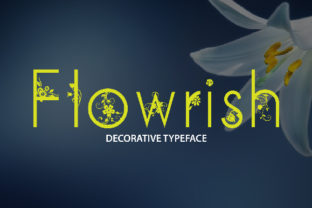
Flowrish is a serif typeface designed with botanical elegance in mind. It’s not merely decorative—it’s intentionally structured to evoke the organic rhythm of vines, petals, and stems while maintaining typographic clarity. Each glyph carries subtle flourishes: tapered terminals, soft swashes on uppercase letters, and delicate ligatures that mimic the way tendrils curl or blossoms unfurl. Unlike many floral fonts that prioritize ornamentation over function, Flowrish balances visual charm with readability at medium sizes—particularly in print and high-resolution digital displays.
What Sets Flowrish Apart from Other Decorative Fonts
Many fonts labeled “floral,” “botanical,” or “hand-drawn” fall into one of two categories: highly stylized display faces meant only for headlines, or overly literal illustrations masquerading as type. Flowrish avoids both extremes. Its letterforms are grounded in classical serif proportions but reinterpreted through a naturalist lens—think Garamond’s structure meeting pressed wildflower specimens. The lowercase a, g, and y feature gentle descenders with curved terminals; capitals include optional swash variants that feel like inked stem extensions rather than arbitrary embellishments.
This attention to botanical logic extends beyond aesthetics. Flowrish includes OpenType features such as contextual alternates and discretionary ligatures, allowing designers to subtly vary character forms without manual intervention—ideal for longer passages where repetition would otherwise dull the effect. It’s also carefully spaced for even texture in body text at 14–18 pt, a rarity among theme-driven fonts.
Where Flowrish Fits Among Nature-Themed Typography
Designers exploring nature-inspired typography often consider several paths: hand-lettered scripts, illustrated typefaces, minimalist sans-serifs with organic weight shifts, or historically rooted serifs adapted for botanical contexts. Flowrish belongs most closely to the last group—but with key distinctions.
Compared to traditional serif fonts like Baskerville or Caslon, Flowrish introduces deliberate irregularity: slight variations in stroke contrast, asymmetrical serifs on certain characters, and a warmth in its curves that evokes handmade printing rather than mechanical precision. Yet it remains more restrained than script-based alternatives (e.g., fonts mimicking calligraphic pen strokes), which often sacrifice legibility in extended use.
It also differs from illustrated fonts—those where flowers or leaves replace parts of letters. Flowrish doesn’t embed literal botanical imagery into glyphs. Instead, its botanical character emerges from form, flow, and spacing. This makes it more versatile across media: scalable without pixelation, usable in vector formats, and compatible with accessibility tools that rely on standard Unicode mapping.
Practical Strengths and Real-World Use Cases
Flowrish excels in projects where tone and theme must align without compromising usability. Wedding stationery benefits from its romantic yet refined presence—invitations, menus, and programs gain quiet sophistication without appearing fussy. Similarly, botanical illustration books, garden center branding, apothecary packaging, and eco-conscious product labels find strong resonance with Flowrish’s voice.
In editorial design, Flowrish works well for pull quotes, chapter headings, and short captions paired with neutral supporting typefaces (e.g., a clean sans-serif like Lora or Merriweather for body text). Its moderate x-height and open counters ensure readability in print layouts, especially on textured or uncoated paper stocks where heavier serifs might bleed.
One practical advantage is its licensing flexibility. Flowrish is available in multiple weights—including regular, italic, bold, and bold italic—with matching metrics. This allows consistent hierarchy without switching families, reducing layout complexity. It also supports Latin Extended-A, covering most Western European languages, making it viable for bilingual publications or international botanical guides.
Tradeoffs and Situational Limitations
No font serves every purpose equally—and Flowrish is no exception. Its ornamental qualities make it less suitable for dense UI interfaces, data dashboards, or legal disclaimers where neutrality and rapid scanning are priorities. At small sizes (<10 pt), especially on low-DPI screens, some of its finer details—like tapered serifs or thin strokes—may blur or disappear entirely. Testing at intended usage size and resolution is essential.
Flowrish also assumes a certain level of typographic awareness from the user. Pairing it effectively requires understanding contrast: its organic flow needs grounding in something structurally stable. Using it alongside similarly decorative fonts risks visual competition; pairing it with ultra-thin or ultra-bold companions can create imbalance. Thoughtful hierarchy—such as reserving swash capitals for initial letters and using the regular weight for body copy—helps maintain cohesion.
Another consideration is audience expectation. In highly technical or corporate contexts—say, a sustainability report for an engineering firm—Flowrish may unintentionally signal informality or lack of gravitas. Here, a more restrained serif or even a humanist sans-serif with subtle warmth (like Chaparral Pro or Source Serif) might better support credibility while still nodding to natural themes through color palette or imagery.
When to Choose Flowrish—and When to Look Elsewhere
Flowrish is the right choice when your project centers on authenticity, craftsmanship, and quiet reverence for the natural world—not just surface-level “green” aesthetics. If you’re designing a field guide for native plants, a seasonal menu for a farm-to-table restaurant, or a limited-edition journal celebrating pollinators, Flowrish contributes meaningfully to narrative cohesion.
It shines where typography plays a supporting yet expressive role—enhancing mood without overshadowing content. Its strength lies in intentionality: each flourish feels earned, not applied. That makes it especially effective in tactile applications—letterpress prints, embossed business cards, foil-stamped book covers—where physical texture reinforces its botanical sensibility.
Conversely, if your work demands maximum legibility under variable conditions (e.g., mobile-responsive websites with dynamic text resizing), or if your brand voice prioritizes modern minimalism over lyrical detail, Flowrish may require careful adaptation—or a different starting point altogether. In those cases, evaluating fonts with higher functional tolerance—like Adobe Garamond Pro (for classic authority) or IBM Plex Serif (for contemporary clarity)—becomes more pragmatic.
Making an Informed Choice
Selecting a font like Flowrish isn’t just about liking how it looks—it’s about understanding how it behaves across contexts, how it interacts with other design elements, and whether its personality aligns with your message’s substance. Ask yourself:
- Will readers encounter this text in environments where fine detail remains visible and legible?
- Does the project benefit from a sense of handcrafted care—or does it need to communicate speed, efficiency, or universality?
- Are there accessibility requirements (e.g., WCAG contrast ratios, screen reader compatibility) that could be affected by stylistic choices?
- How much time and expertise can be invested in fine-tuning spacing, pairing, and feature activation?
Flowrish rewards thoughtful implementation. It’s not a shortcut to “nature vibes”—it’s a tool for designers who value nuance, understand typographic history, and seek harmony between form and function. Used deliberately, it adds quiet distinction. Used without consideration, it can distract or dilute.
Ultimately, Flowrish invites a slower kind of design thinking—one aligned with the very subject it represents. Its beauty isn’t loud or immediate, but cumulative: revealed through repeated use, careful pairing, and respect for context. That makes it less of a trend and more of a considered resource—for the right project, at the right time, with the right intent.