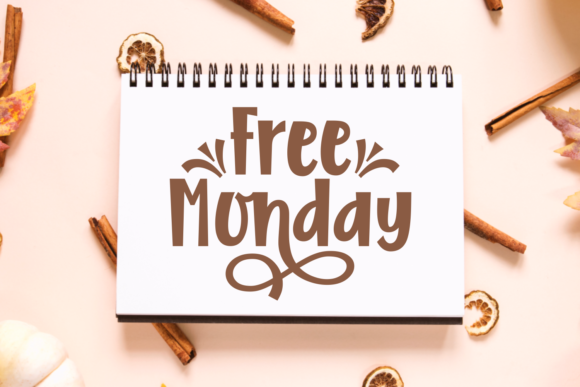
Free Monday: Playful Handwritten Font
Imagine opening a design project and instantly feeling lighter—like the first sip of coffee on a quiet Monday morning. That’s the subtle lift Free Monday brings. It’s not just another handwritten font. It’s a carefully crafted, open-source typeface with uneven baselines, gentle slant variations, and intentional imperfections that echo real pen-on-paper movement. The result? A warmth and authenticity many digital fonts struggle to replicate.
Why “Easy Like Monday Morning” Isn’t Just a Tagline
The phrase “Easy like Monday morning” captures something essential about Free Monday: it lowers friction without sacrificing intention. Unlike highly stylized scripts that demand precise kerning or tight layout control, Free Monday works comfortably at medium sizes (16–24px) in body text, headlines, and even short callouts. Its letterforms have generous spacing and clear distinction between similar characters—like a and o, or l and i—so readability stays strong, even on screens or printed handouts.
This ease matters most when time is scarce. A small business owner updating their weekly newsletter doesn’t need to spend 20 minutes adjusting tracking or rewriting copy to fit a finicky script. With Free Monday, they can drop it in, adjust weight if needed (it includes regular and bold weights), and move forward—keeping tone friendly and human without over-engineering.
Where That Personal Feel Makes a Real Difference
“Personal feel” isn’t decorative—it’s functional communication. Consider an educator designing a classroom welcome slide. Using a sterile sans-serif says “institution.” Switching to Free Monday signals approachability, care, and presence—subtly reinforcing that this space belongs to students, not just syllabi. Similarly, a freelance illustrator adding a short caption to a portfolio image gains cohesion: the font’s organic rhythm mirrors the hand-drawn quality of their work, making the whole piece feel unified, not layered.
Bloggers writing reflective or lifestyle content also benefit. When readers scan a post titled *How I Started Saying No Without Guilt*, seeing that headline set in Free Monday primes them for honesty and vulnerability—not polish. It aligns typography with voice, reducing cognitive load and building trust faster than a generic font ever could.
Who Gains the Most—and Why
Free Monday shines for creators who balance craft with constraints: educators preparing materials between classes, solopreneurs managing their own branding, nonprofit staff designing community flyers on tight budgets, or indie publishers laying out zines with limited design software. Its open-source license means no licensing checks, no vendor lock-in, and seamless use across platforms—from Canva and Figma to Google Docs and Adobe Express.
It’s especially helpful for those avoiding overdesigned aesthetics. If your brand values sincerity over slickness—if “handmade,” “thoughtful,” or “unhurried” are part of your vocabulary—Free Monday supports that quietly, consistently. It doesn’t shout. It listens, then responds with warmth.
Real-World Use Cases That Go Beyond Decoration
- Email subject lines: A wellness coach using Free Monday for a subject like *Your 5-Minute Reset Is Ready* adds tactile softness that stands out in a crowded inbox—without triggering spam filters (it renders cleanly as web-safe fallbacks when needed).
- Workshop handouts: Facilitators printing takeaways notice how Free Monday’s open counters and moderate contrast improve scannability—even on recycled paper or basic printers.
- Social media carousels: When overlaying short quotes on photos, Free Monday’s natural variation prevents visual monotony. Each line feels like part of a conversation, not a broadcast.
A Note on Fit—and When to Look Elsewhere
Free Monday excels in warmth and approachability—but it’s not built for every context. It’s not ideal for dense legal disclaimers, multilingual interfaces requiring extensive diacritics, or ultra-narrow columns where tight letterfit is critical. Its charm lies in breathing room and gentle irregularity; forcing it into rigid grids or tiny UI labels can dilute its strength.
If your project needs high legibility at 12px in a dashboard, or supports Arabic, Devanagari, or Vietnamese natively, explore alternatives with broader language coverage. Likewise, if you require variable font axes (like continuous weight or width control), Free Monday won’t deliver that flexibility—it’s intentionally focused, not expansive. Knowing those boundaries helps you choose wisely, not just quickly.
Small Adjustments, Meaningful Shifts
You don’t need to overhaul your entire system to test Free Monday. Try it in one high-impact spot: the byline on your blog post, the “thank you” note in your email footer, or the title slide of your next presentation. Notice how it changes the perceived temperature of the interaction—less transactional, more relational.
Pair it thoughtfully: a clean, neutral sans-serif (like Inter or Open Sans) for supporting text creates respectful contrast. Avoid pairing it with other handwritten fonts—that risks visual noise. And skip all-caps usage; Free Monday’s personality lives in its lowercase flow and natural ascenders/descenders.
More Than a Font—A Design Mindset
Using Free Monday gently encourages a shift in how you think about communication. It reminds you that clarity doesn’t require sterility, and professionalism doesn’t demand uniformity. In a world saturated with algorithmically optimized templates, choosing a font that looks like it was drawn by hand—yet remains highly functional—is itself a quiet act of intention.
That’s why so many teachers, therapists, makers, and community organizers return to it. Not because it’s trendy, but because it fits how they want to show up: grounded, kind, and unmistakably human.